Introduction
Selecting a plastic pipe manufacturer affects far more than material cost: it influences system life, compliance, installation performance, and the risk of costly failures. For buyers comparing HDPE, PVC, or PEX suppliers, the key question is not simply who can quote fastest, but who can consistently deliver pipes that meet specification under real operating conditions. This checklist explains the practical indicators of reliability, from raw material control and testing standards to production consistency, certifications, and delivery capability. By the end, you will know how to screen manufacturers more effectively, ask better technical questions, and reduce procurement risk before a purchase order is placed.
Why Choosing a Reliable Plastic Pipe Manufacturer Matters
Securing a reliable plastic pipe manufacturer is a foundational requirement for modern infrastructure, commercial plumbing, and industrial fluid transport projects. The integrity of piping systems—whether utilizing high-density polyethylene (HDPE), polyvinyl chloride (PVC), or cross-linked polyethylene (PEX)—dictates the operational lifespan of the entire network.
Procurement professionals and project engineers must look beyond the initial unit price per linear foot. A manufacturer’s internal quality controls, resin sourcing, and logistical capabilities directly impact the total cost of ownership, regulatory compliance, and the structural safety of the end-use application.
Failure costs and project risks
The financial repercussions of deploying substandard plastic piping extend far beyond initial procurement savings. When a pipe experiences a hydrostatic failure, environmental stress cracking, or joint rupture, the direct replacement costs frequently exceed 10 to 15 times the original material expenditure. In municipal water or industrial chemical applications, a catastrophic pipeline failure can incur upwards of $500,000 per incident when factoring in deep excavation, environmental remediation, and facility downtime.
Compromised wall thickness or incorrect standard dimension ratios (SDR) are common in lower-tier manufacturing. If a supplier cuts corners on polymer density, a pipe specified for SDR 11 high-pressure applications may fail under lower SDR 17 pressure thresholds, underscoring the severe operational risks of inadequate manufacturing controls.
Delivery reliability and supply continuity
Beyond physical product integrity, supply chain reliability dictates project viability. Large-scale civil installations rely heavily on just-in-time delivery schedules to prevent site congestion and mitigate material degradation from prolonged UV exposure on job sites. Manufacturers lacking robust logistics and inventory buffers introduce critical labor bottlenecks.
In public infrastructure projects, delivery delays can trigger severe liquidated damages, often ranging from $1,000 to $10,000 per day depending on the contract structure. Ensuring a manufacturer has the operational maturity and redundant production lines to maintain supply continuity—even amid global raw material shortages—is essential for mitigating schedule overruns.
How to Identify a Reliable Plastic Pipe Manufacturer
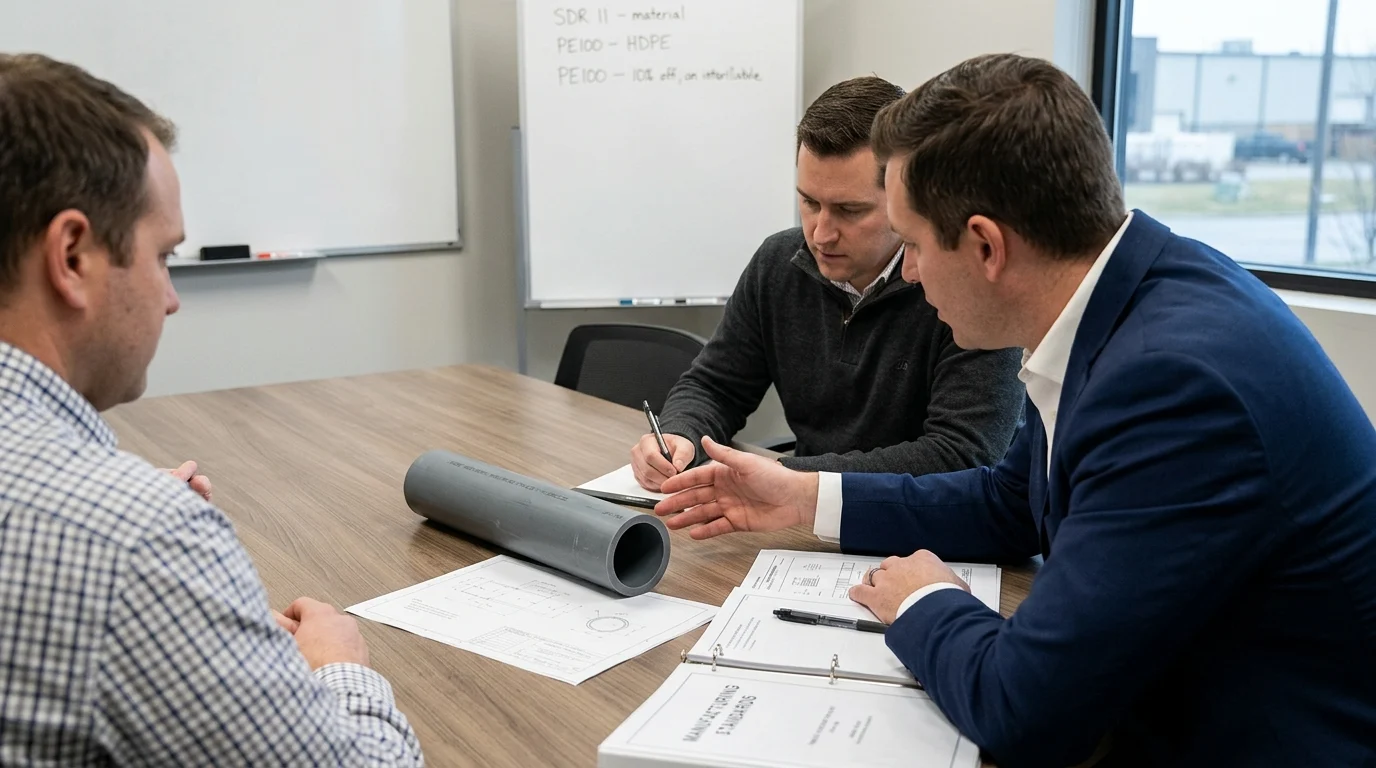
Distinguishing a premier plastic pipe manufacturer from an opportunistic supplier requires a deep dive into their operational methodologies. Buyers must assess technical parameters rather than relying on marketing claims to ensure the manufacturer can consistently meet rigorous engineering specifications.
Material and product quality indicators
The foundation of any high-performance plastic pipe is the quality of its base resin. Top-tier manufacturers strictly utilize certified, prime virgin resins tailored to specific applications, such as bimodal PE100 for demanding pressure networks. High-quality PE100 resin should demonstrate a minimum required strength (MRS) of 10.0 MPa at 20°C for a 50-year design life.
Conversely, unreliable suppliers frequently dilute virgin material with excessive post-industrial or post-consumer regrind to lower costs. Introducing more than 5% unverified regrind drastically reduces the pipe’s hydrostatic design basis (HDB) and increases susceptibility to rapid crack propagation. Evaluating a supplier’s resin certificates of analysis (CoA) is a mandatory first step.
Manufacturing consistency across pipe types
A manufacturer’s capability is often revealed by their extrusion consistency across varied pipe diameters and material types. The extrusion process must maintain strict concentricity; uneven wall thickness creates weak points prone to bursting under surge pressures. Advanced facilities utilize ultrasonic in-line thickness gauges and closed-loop gravimetric dosing systems to maintain dimensional tolerances within fractions of a millimeter.
Whether producing 1/2-inch PEX for residential plumbing or 48-inch corrugated HDPE for stormwater management, the manufacturer must demonstrate a uniform coefficient of variation across their entire catalog. High variance between batches signals poor machinery calibration or inadequate operator training.
Supplier evaluation checklist
To systematically identify competent partners, procurement teams should utilize a standardized evaluation framework. The table below highlights key differentiators between reliable, tier-1 manufacturers and lower-tier alternatives.
| Evaluation Metric | Tier 1 Manufacturer | Tier 2 Manufacturer |
|---|---|---|
| Resin Source | 100% certified virgin PE100/PVC | Mixed batches, >5% unverified regrind |
| Extrusion Tolerance | Highly concentric, strict OD/ID control | High variance in wall thickness |
| Defect Rate | < 0.5% batch rejection | Volatile, often > 2.0% rejection rate |
| Traceability | Fully automated barcode/laser etching | Manual or incomplete batch logging |
Compliance, Testing, and Documentation Standards
Regulatory compliance is non-negotiable, particularly for municipal waterworks, chemical processing, and potable water applications. A reliable manufacturer operates transparently, maintaining rigorous testing protocols and up-to-date certifications from recognized global standards organizations.
Certifications and dimensional standards
Reputable manufacturers design and test their products against stringent international frameworks such as ASTM, AWWA, ISO, and DIN. For example, a manufacturer producing PVC sewer pipe must ensure compliance with ASTM D3034, which dictates a minimum pipe stiffness of 46 psi (320 kPa) to withstand deep burial loads without hazardous deflection.
For potable water systems, certifications like NSF/ANSI 61 or WRAS are legally required to guarantee that the plastic compound does not leach toxic volatile organic compounds (VOCs) or heavy metals into the drinking water supply. Buyers must request current, unexpired certification dossiers and verify them directly with the issuing bodies to avoid counterfeit documentation.
Third-party testing and quality control
Internal quality assurance is vital, but validation by accredited third-party laboratories provides the ultimate proof of reliability. Manufacturers should routinely subject their pipes to destructive testing protocols, including hydrostatic burst testing, melt flow index (MFI) verification, and oxidation induction time (OIT) analysis.
OIT is particularly critical for assessing long-term thermal stability. Premium HDPE pipe must yield an OIT exceeding 20 minutes at 200°C. If a manufacturer’s testing documentation shows values dropping below this threshold, it indicates inadequate antioxidant stabilization in the resin, which will drastically shorten the pipe’s field lifespan.
How to Evaluate Capacity, Logistics, and Service
A manufacturer’s ability to produce high-quality pipe is only advantageous if they possess the logistical footprint and operational capacity to fulfill large-scale orders efficiently. Evaluating the commercial and service-oriented aspects of a supplier ensures alignment with project timelines and procurement budgets.
Supplier audits and lead time verification
Conducting a comprehensive supplier audit allows buyers to verify actual extrusion line capacity against stated marketing claims. A robust facility equipped to handle large municipal contracts should output between 10,000 and 50,000 metric tons annually. Assessing machine utilization rates helps determine if the supplier has the bandwidth to absorb surge orders.
Lead time verification is equally critical. Standard lead times for common dimensional ratios should stabilize around 3 to 6 weeks. If a manufacturer quotes lead times exceeding 12 weeks for standard PVC or HDPE runs, it may indicate severe supply chain vulnerabilities, inadequate resin stockpiles, or outdated extrusion technology.
Pricing, MOQ, and freight considerations
Because plastic pipe is inherently bulky, buyers effectively pay to ship a high volume of “air.” Consequently, freight costs can account for 15% to 30% of the total delivered price. Reliable manufacturers optimize logistics by nesting pipes where permissible or utilizing strategically located regional distribution hubs to minimize freight miles.
Minimum Order Quantities (MOQs) must also align with project phasing. Typical MOQs for custom extrusions or non-standard SDRs are approximately one full container load (FCL) or 40,000 lbs. Buyers should negotiate flexible MOQ terms for pilot projects or maintenance stock to avoid tying up capital in excessive inventory.
Procurement scorecard and comparison matrix
To objectively compare multiple plastic pipe manufacturers, buyers should implement a weighted procurement scorecard. This matrix quantifies both technical and commercial variables, stripping emotion from the sourcing decision.
| Performance Metric | Weighting (%) | Minimum Target Threshold |
|---|---|---|
| Quality Pass Rate | 40% | > 99.5% compliance across all tested batches |
| On-Time Delivery | 30% | > 95% of shipments arriving on or before the promised date |
| Cost Competitiveness | 15% | Within 5% of the regional market benchmark |
| Capacity Utilization | 15% | < 85% steady state (allowing room for surge orders) |
Final Checklist for Selecting the Right Manufacturer

Synthesizing technical assessments, compliance checks, and logistical audits into a cohesive procurement strategy is the final hurdle. A structured qualification process prevents costly missteps and establishes a foundation for long-term strategic partnerships rather than volatile transactional buying.
Step-by-step qualification process
The qualification process should follow a disciplined, phased approach. It begins with a Request for Information (RFI) to screen basic capabilities, followed by a detailed Request for Quotation (RFQ) that includes strict engineering specifications. Buyers must then request physical samples and corresponding batch test reports for independent laboratory verification.
Before awarding a multi-million dollar contract, executing a pilot order is highly recommended. A pilot order representing 5% to 10% of the total project volume allows the procurement team to validate the manufacturer’s real-world lead times, packaging integrity, and batch-to-batch consistency under low-risk conditions.
Final selection criteria
Final selection hinges on finding the optimal balance between commercial terms and uncompromised technical capability. The chosen manufacturer must not only meet the required pressure ratings and dimensional standards but also demonstrate robust financial health, transparent communication, and a proven track record in the specific application sector.
Ultimately, a reliable plastic pipe manufacturer acts as an extension of the project engineering team. By prioritizing stringent quality controls, verified resin sourcing, and scalable logistics, buyers safeguard their infrastructure investments and ensure decades of leak-free performance.
Key Takeaways
- The most important conclusions and rationale for Reliable Plastic Pipe
- Specs, compliance, and risk checks worth validating before you commit
- Practical next steps and caveats readers can apply immediately
Frequently Asked Questions
What certifications should a reliable plastic pipe manufacturer provide?
Ask for product-specific compliance, factory quality certificates, and resin CoA documents. A dependable supplier should also provide batch traceability and test records for pressure, dimensions, and material consistency.
How can buyers verify pipe material quality before ordering?
Request virgin resin details, test reports, and sample inspection. Check wall thickness, SDR tolerance, and clear batch marking to confirm the pipe matches the specified application.
Why does manufacturing consistency matter for plastic pipes?
Consistent extrusion reduces weak spots, leakage risk, and premature failure. Buyers should confirm the manufacturer controls concentricity, diameter tolerance, and batch rejection rates across all pipe sizes.
Can Donsen supply different plastic piping systems for one project?
Yes. Donsen offers PP-R, PVC, CPVC, PE, and PE-RT pipes and fittings, plus valves, supporting water supply, irrigation, drainage, and floor heating projects from one supplier.
What delivery factors should be checked when choosing a manufacturer?
Confirm production capacity, export experience, lead times, and backup supply capability. For international buyers, a manufacturer with multiple production bases and stable shipping support helps avoid project delays.