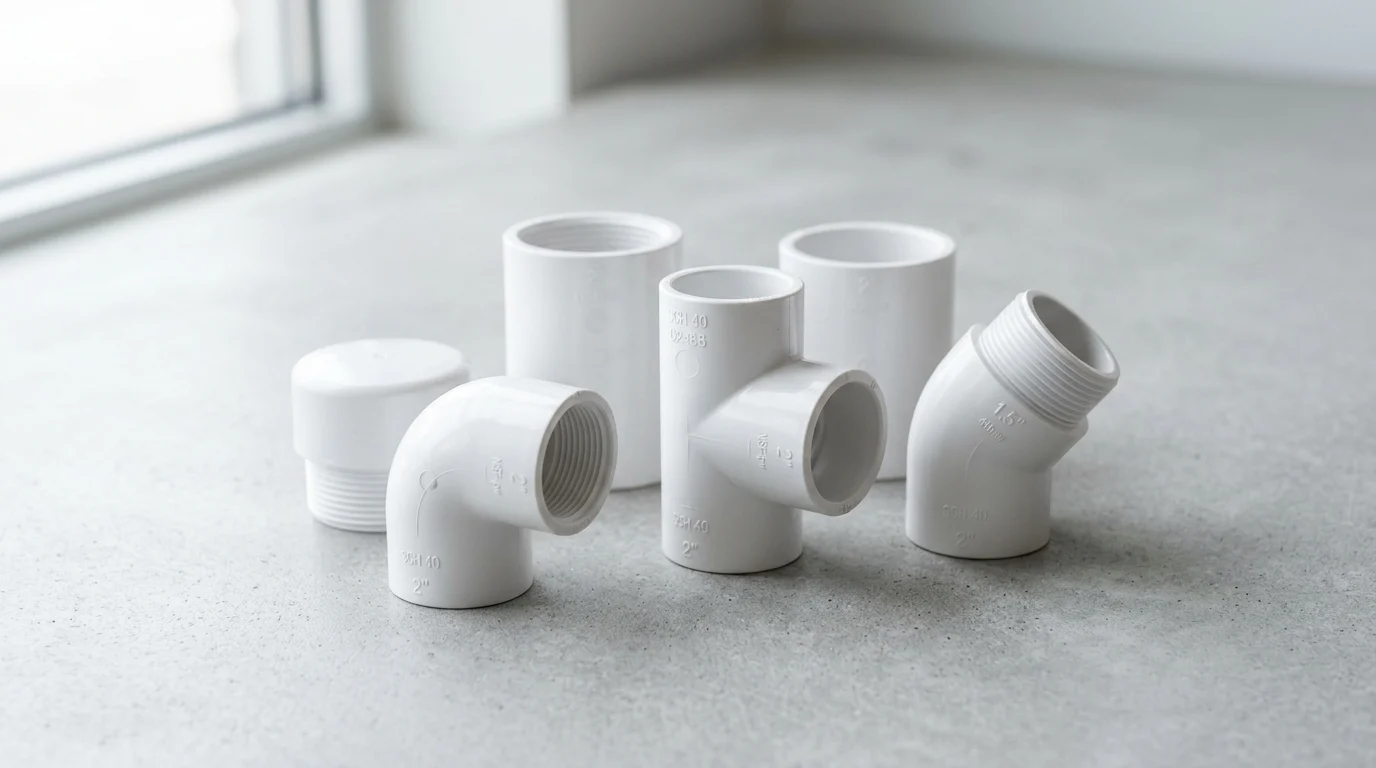
Key PVC Fitting Standards
What are the standards for PVC fittings? The specification and manufacturing of these components are governed by a comprehensive set of international guidelines—primarily from ASTM, NSF, AWWA, ISO, and EN. These standards guarantee mechanical integrity, chemical resistance, and safe fluid transport. Engineers and piping designers rely on these documents to ensure interoperability and long-term reliability in both pressure and non-pressure applications.
Navigating this landscape requires an understanding of how regional bodies and independent testing laboratories classify polymer materials. Compliance with these frameworks is essential for commercial, industrial, and municipal infrastructure projects.
Material and Pressure Requirements
Base material formulations must adhere to strict cell classifications to ensure baseline mechanical properties. For example, rigid, unplasticized polyvinyl chloride (UPVC) used in standard pressure applications typically requires an ASTM D1784 cell classification of 12454. This specific numeric designation dictates a minimum tensile strength of 7,000 psi and a minimum tensile modulus of elasticity of 400,000 psi.
Furthermore, baseline pressure requirements mandate that components withstand specific hydrostatic burst pressures. Depending on the geometry and nominal size, fittings are often tested to withstand internal pressures exceeding 1,000 psi at 73°F (23°C) during laboratory evaluations, ensuring a robust safety factor prior to field deployment.
ASTM, NSF, AWWA, CSA, EN, and ISO Standards
The regulatory landscape is divided among several dominant organizations. In North America, ASTM D2466 and ASTM D2467 govern the dimensions, workmanship, and burst pressure requirements for Schedule 40 and Schedule 80 fittings, respectively. It is important to note that while these standards govern the fittings specifically, overall system pressure ratings also depend on pipe compatibility. Potable water applications require NSF/ANSI 14 for physical performance and NSF/ANSI 61 for health effects, ensuring no toxic leaching into drinking water supplies.
Globally, ISO 1452 and EN 1452 dictate the specifications for metric-sized piping systems. These standards classify components by Nominal Pressure (PN) ratings, such as PN10 or PN16, which correspond to 10 bar and 16 bar maximum continuous operating pressures at standard temperatures. Additionally, the AWWA C900 standard plays a critical role for municipal water distribution networks, requiring higher safety multipliers to accommodate cyclic surge pressures.
Comparing Standards by Performance

Evaluating different standards requires a comparative analysis of physical geometries and the resulting system performance. The primary differentiator in fluid handling systems is the wall thickness profile, which directly dictates the maximum allowable working pressure (MAWP) and the component’s resistance to external mechanical stress.
Engineers must weigh these physical characteristics against the flow requirements of the system, understanding that increased pressure ratings often come with geometric trade-offs that affect flow rates and friction losses.
Schedule 40 and Schedule 80 Differences
The distinction between Schedule 40 and Schedule 80 systems is rooted in their respective ASTM dimensional standards. Schedule 80 components feature a significantly heavier wall thickness, allowing them to handle higher internal pressures and greater mechanical loads, making them the default choice for industrial processing.
| Nominal Size (Inches) | Sch 40 Wall Thickness (in) | Sch 80 Wall Thickness (in) | Sch 40 Max Pressure (psi) | Sch 80 Max Pressure (psi) |
|---|---|---|---|---|
| 1″ | 0.133 | 0.179 | 450 | 630 |
| 2″ | 0.154 | 0.218 | 280 | 400 |
| 4″ | 0.237 | 0.337 | 220 | 320 |
Note: Pressure ratings are based on water at 73°F (23°C). This added material thickness in Schedule 80 components slightly reduces the internal diameter, which engineers must account for when calculating fluid velocity and dynamic friction loss across the network.
Dimensions, Formulation, and Pressure Ratings
Dimensional tolerances for socket depths and interference fits are carefully defined to ensure solvent cement joints achieve full chemical fusion without bottoming out prematurely. Beyond geometric dimensions, the compound formulation heavily impacts thermal stability.
While standard polyvinyl chloride maintains structural integrity up to a maximum operating temperature of 140°F (60°C), its pressure handling capacity diminishes rapidly as temperatures rise. Industry standards require a thermal derating factor to be applied in system design. For instance, according to standard manufacturer derating charts, at 110°F (43°C), the working pressure of a component is typically derated by a factor of 0.51 from its baseline 73°F rating. Failing to account for these formulation limits and pressure deratings can lead to system failure under high-temperature flow conditions.
Compliant Sourcing and Specification
Specifying the correct standard is only the first step; securing compliant PVC fittings through rigorous supply chain verification is equally critical. Procurement professionals and engineers must collaborate to validate that incoming inventory strictly adheres to the mandated geometric and material specifications.
Without strict quality control and documentation checks, the risk of integrating counterfeit or substandard materials increases, potentially compromising the safety and lifespan of the entire piping network.
Supplier Documentation Checks
Robust supplier documentation is the primary defense against substandard materials. Buyers should request Material Test Reports (MTRs) that confirm the correct cell class and verify the absence of prohibited heavy metal stabilizers, such as lead or cadmium. Facility certifications, particularly ISO 9001, indicate a baseline of manufacturing consistency.
Additionally, quality control audits should verify that the manufacturer maintains an Acceptable Quality Limit (AQL) of 1.5% or lower for dimensional deviations in socket diameters and wall thicknesses. Third-party certification marks, such as the NSF-pw (potable water) stamp, must be permanently molded or printed on the product body and supported by valid, unexpired certificates from the issuing testing laboratory.
Selection Criteria for Project Requirements
Selecting the appropriate components requires aligning the project’s environmental and operational demands with specific standard criteria. For outdoor installations exposed to direct sunlight, specifications often mandate formulations with adequate titanium dioxide (TiO2) content—frequently cited by manufacturers as around 9 parts per hundred resin (phr)—to provide UV resistance and prevent impact strength degradation over time.
Chemical processing applications necessitate cross-referencing the fluid’s aggressiveness against the manufacturer’s chemical resistance charts, often pushing the specification toward Schedule 80 for the added corrosion allowance.
To ensure a successful installation, engineers should follow a practical checklist:
- Verify standard compatibility:
Key Takeaways
- Verify the governing standard before specifying PVC fittings, such as ASTM D2466 for Schedule 40, ASTM D2467 for Schedule 80, or ISO 1452 and EN 1452 for metric systems.
- Use NSF/ANSI 14 and NSF/ANSI 61 certified PVC fittings for potable water applications to confirm both physical performance and drinking-water safety.
- Check the material classification for pressure fittings, because ASTM D1784 cell class 12454 requires at least 7,000 psi tensile strength and 400,000 psi tensile modulus.
- Select Schedule 80 fittings when higher internal pressure or mechanical loading is expected, since their heavier wall thickness offers greater strength than Schedule 40.
- Match pressure ratings to the application, including PN10 or PN16 for metric systems and AWWA C900 requirements for municipal water distribution with surge conditions.
Frequently Asked Questions
Which standards apply to PVC fittings?
Common PVC fitting standards include ASTM D2466 for Schedule 40, ASTM D2467 for Schedule 80, NSF/ANSI 14 and 61 for performance and potable water safety, AWWA C900 for municipal water systems, and ISO 1452 or EN 1452 for metric pressure piping.
What is ASTM D1784 for PVC fittings?
ASTM D1784 defines PVC material cell classifications. For many rigid UPVC pressure applications, cell class 12454 is used, requiring minimum tensile strength of 7,000 psi and tensile modulus of 400,000 psi.
Are Schedule 40 and Schedule 80 PVC fittings the same?
No. Schedule 80 fittings have thicker walls than Schedule 40 fittings, giving them higher pressure and mechanical load capacity. Schedule 40 is common for general plumbing, while Schedule 80 is often selected for more demanding industrial applications.
What standards are needed for potable water PVC fittings?
Potable water PVC fittings should comply with NSF/ANSI 14 for physical performance and NSF/ANSI 61 for health effects, confirming the material is suitable for drinking water and does not leach harmful contaminants.
What do PN10 and PN16 mean for PVC fittings?
PN ratings are used in ISO and EN metric systems. PN10 means a maximum continuous operating pressure of 10 bar, while PN16 means 16 bar, typically at standard operating temperatures.