Introduction
PVC valves are widely used in fluid systems because they combine corrosion resistance, low weight, and competitive cost, but selecting the right valve depends on more than material alone. Grade differences, pressure class, temperature limits, and media compatibility all affect service life and safety. This article explains how common PVC material grades compare, how pressure ratings are defined and applied in real operating conditions, and where these valves fit best across industrial, water treatment, and chemical handling systems. With that context, the body will help you match valve specifications to application demands and avoid common selection mistakes.
Why PVC valves matter in industrial fluid handling
Polyvinyl chloride (PVC) valves are a cornerstone of modern industrial fluid management, offering a highly engineered alternative to traditional metallic piping components. As process facilities increasingly face aggressive chemical environments and stringent purity requirements, thermoplastic flow control solutions have transitioned from niche alternatives to baseline specifications. The inherent molecular structure of PVC provides unique advantages in operational longevity and system design flexibility.
Understanding the strategic deployment of these valves requires evaluating their mechanical properties against the specific demands of industrial environments. By leveraging advanced polymer formulations, facility engineers can achieve precise flow regulation while mitigating the persistent threat of internal and external pipeline degradation.
Corrosion resistance and installed cost
The primary driver for specifying thermoplastic valves is their absolute immunity to galvanic and electrolytic corrosion. Unlike metallic alloys, which rely on passive oxide layers that can be compromised by localized pitting or crevice corrosion, PVC remains chemically inert to a vast spectrum of acids, bases, and salts. This eliminates the need to calculate Pitting Resistance Equivalent Numbers (PREN) when handling harsh media.
From a capital expenditure standpoint, utilizing these valves frequently yields a 30% to 50% reduction in installed costs compared to 316 stainless steel or specialized alloys for equivalent bore sizes. This financial advantage extends into the operational phase; the absence of scaling and tuberculation maintains a smooth internal bore, preserving optimal flow coefficients (Cv) and reducing the energy required for fluid transport over the system’s lifecycle.
Where PVC valves outperform metal
Thermoplastic valves demonstrate superior performance in environments characterized by high chloride concentrations, such as sodium hypochlorite dosing, desalination plants, and chlor-alkali processing. In these applications, even high-grade stainless steels are susceptible to rapid stress corrosion cracking, whereas PVC maintains structural integrity without degradation.
Furthermore, the physical characteristics of the material streamline logistics and installation. With a specific gravity ranging from 1.38 to 1.45, PVC is approximately one-sixth the weight of carbon steel. This significant weight reduction minimizes the need for heavy structural supports, simplifies rigging during installation, and lowers the structural load on complex piping manifolds, particularly in modular skid-mounted systems.
PVC material grades and valve types
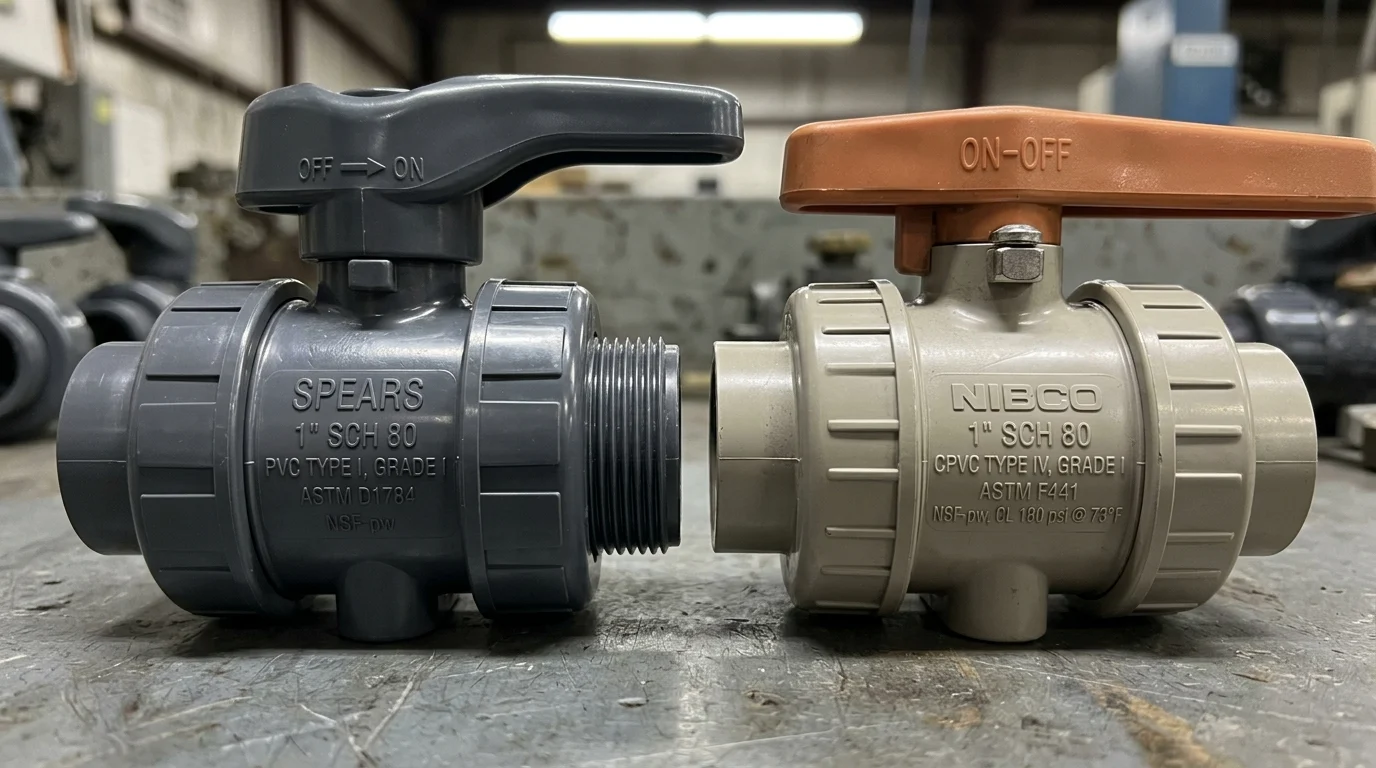
Although the umbrella term “PVC” is widely used in industrial procurement, process applications necessitate precise differentiation among polymer grades. The mechanical and thermal limitations of a valve are fundamentally dictated by its base resin formulation, making material selection the most critical step in the engineering design phase.
PVC, CPVC, and UPVC differences
Unplasticized PVC (UPVC) is the standard rigid material used in most industrial valves, formulated without the plasticizers that make commercial PVC flexible. It offers excellent chemical resistance but is thermally limited. Chlorinated PVC (CPVC) undergoes a post-chlorination process that increases its chlorine content, significantly elevating its thermal tolerance and mechanical strength at higher temperatures.
| Material Grade | Max Operating Temp | Tensile Strength (psi) | Primary Industrial Application |
|---|---|---|---|
| UPVC (Standard) | 140°F (60°C) | 7,200 | Ambient water treatment, chemical transfer |
| CPVC | 200°F (93°C) | 8,000 | Hot corrosive liquids, industrial acid processing |
Selecting between these grades requires matching the normal operating temperature and the potential peak thermal excursions of the process media to the material’s structural limits.
Common valve types and use cases
Ball valves represent the most ubiquitous thermoplastic valve type, typically specified in sizes ranging from 1/2-inch to 4-inch nominal pipe size (NPS). Their true union design allows the central valve body to be removed from the pipeline for maintenance without altering the adjacent piping. They are highly favored for on/off isolation applications due to their minimal pressure drop and rapid actuation capabilities.
For larger pipe diameters up to 12 inches, butterfly valves become the standard due to their compact face-to-face dimensions and lower weight profile. Diaphragm valves are uniquely suited for throttling applications and for handling slurries or media containing suspended solids. Their internal geometry isolates the mechanical components from the fluid stream, ensuring a high degree of purity and zero dead-leg zones.
How to compare materials and designs
Comparing valve designs requires evaluating internal geometries and elastomer compatibility. While the valve body may be highly resistant to the process media, the internal seals (O-rings and diaphragms) are often the weakest link. Engineers must rigorously verify the chemical compatibility of sealing materials, typically choosing between EPDM for aqueous and alkaline solutions, or FKM (Viton) for aggressive acids and halogenated compounds.
Additionally, the internal machining and molding tolerances dictate the valve’s susceptibility to particulate accumulation. High-purity applications demand valves manufactured in cleanroom environments with polished internal surfaces to prevent microbial growth and particulate shedding.
Pressure, temperature, and flow selection
The structural integrity of thermoplastic piping systems is highly dependent on the inverse relationship between temperature and pressure resistance. Unlike metallic valves, which maintain relatively stable pressure ratings across broad temperature ranges, PVC valves exhibit viscoelastic behaviors that demand precise engineering calculations to prevent catastrophic failure under thermal load.
Pressure classes and schedule ratings
Industrial PVC valves are typically manufactured to Schedule 80 dimensions to provide the necessary wall thickness for threading and industrial pressure handling. This offers a baseline pressure rating of 150 psi for non-shock water applications at ambient temperatures (73°F/23°C).
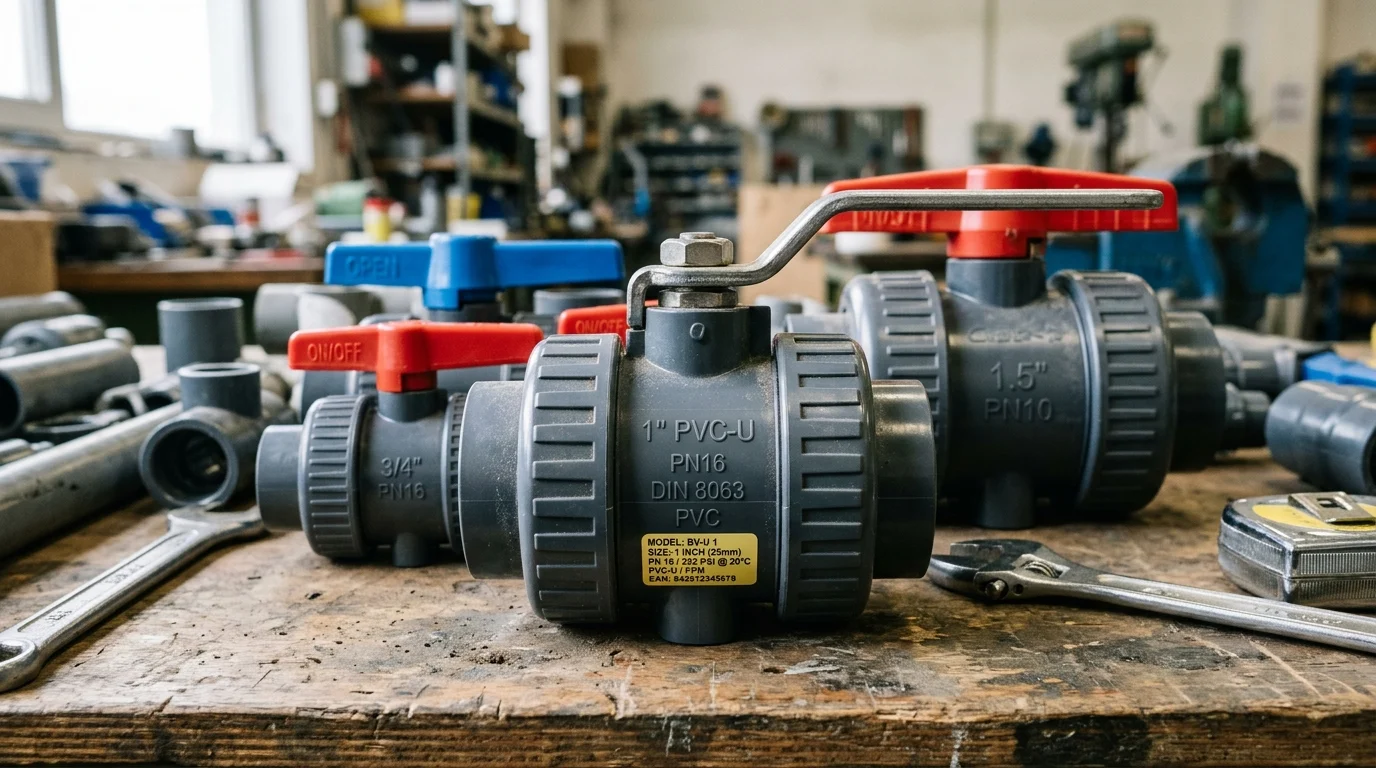
European and international standards often use Pressure Nominal (PN) ratings. For example, a valve rated at PN16 guarantees 16 bar (approximately 232 psi) of pressure resistance at 20°C. It is imperative to understand that these pressure classes represent the absolute maximum non-shock operating pressure under ideal, ambient conditions.
Temperature derating and media compatibility
As media temperatures rise, the pressure-bearing capacity of PVC diminishes linearly, necessitating strict temperature derating. Engineers must apply a mathematical multiplier to the nominal pressure rating to determine the maximum allowable working pressure at elevated temperatures.
| Operating Temp (°F) | UPVC Derating Factor | CPVC Derating Factor |
|---|---|---|
| 73°F | 1.00 | 1.00 |
| 100°F | 0.62 | 0.82 |
| 120°F | 0.40 | 0.65 |
| 140°F | 0.22 | 0.50 |
| 200°F | Not Recommended | 0.20 |
For instance, a standard UPVC valve rated for 150 psi at 73°F can only safely handle 33 psi when operating at 140°F (150 psi × 0.22). Failing to apply these derating factors is a leading cause of thermoplastic system ruptures.
Common specification mistakes
A frequent engineering oversight is the failure to account for hydraulic shock, commonly known as water hammer. Fast-acting PVC ball valves, particularly those equipped with pneumatic actuators, can arrest fluid momentum instantaneously. This generates a surge pressure multiplier of 1.5x to 2x the nominal system pressure, which can easily exceed the material’s tensile limits.
Another common specification error involves using threaded PVC connections in high-pressure or highly fluctuating thermal environments. The threading process cuts into the pipe wall, reducing its effective thickness and establishing stress concentration points. For critical industrial applications, flanged or solvent-welded true union connections are strictly preferred over threaded joints.
Applications, compliance, and installation
Translating theoretical material advantages into operational reliability requires strict adherence to industry standards and proper deployment protocols. The successful integration of PVC valves spans a variety of highly regulated sectors, demanding precise installation methodologies to ensure long-term, leak-free performance.
Typical industrial applications
In the semiconductor manufacturing sector, UPVC valves are heavily relied upon to transport ultrapure water (UPW) requiring resistivity levels of 18.2 MΩ·cm, where any metallic ion leaching would destroy microchip yields. Their high-purity formulations prevent the shedding of total organic carbon (TOC) into the process stream.
In municipal water treatment and desalination, these valves routinely handle aggressive coagulants, such as ferric chloride and alum, alongside highly concentrated sodium hypochlorite. The mining and metal finishing industries also deploy them extensively for acid recovery lines and electroplating baths, environments that would rapidly degrade conventional steel infrastructure.
Standards and certification requirements
Industrial compliance mandates specific material cell classifications and testing protocols. Under ASTM D1784, standard rigid PVC must meet Cell Class 12454, which defines minimum thresholds for base resin, impact strength, tensile strength, and modulus of elasticity. For CPVC, the required designation is typically Cell Class 23447.
When valves are used in municipal potable water systems, they must achieve NSF/ANSI 61 certification to guarantee that no harmful chemicals leach into the drinking water supply. Furthermore, industrial-grade valves should comply with ISO 16135 for industrial ball valves or ISO 16138 for diaphragm valves, which dictate strict design, testing, and torque requirements for the valve bodies.
Installation practices for reliable sealing
Thermoplastic flanged connections demand rigorous torque control to prevent flange cracking and uneven seal compression. For a standard 2-inch PVC flange, engineers must strictly apply 15 to 25 ft-lbs of torque, using a calibrated torque wrench in a sequential, crisscross star pattern. Over-tightening is a primary cause of mechanical failure in thermoplastic flanges.
When executing solvent-cemented joints, proper curing time is non-negotiable. While initial set times may be achieved in minutes, a full cure capable of withstanding industrial pressures generally requires 24 to 48 hours depending on ambient humidity and temperature. Installers must use industrial-grade, heavy-bodied solvent cements and appropriate primers specifically formulated for chemical applications.
How to choose the right PVC valve
Procuring the optimal PVC valve extends beyond matching technical specifications to encompassing total cost of ownership (TCO) and supply chain reliability. As industrial processes become increasingly automated, the selected valves must integrate seamlessly with existing control architectures while providing predictable maintenance intervals.
Lifecycle cost and supplier evaluation
Evaluating lifecycle costs requires analyzing the mean time between failures (MTBF) and the availability of replacement parts. High-quality industrial PVC valves are engineered for a lifecycle of 10,000 to 50,000 actuation cycles under nominal conditions. Supplier evaluation should scrutinize the manufacturer’s quality control tolerances; leading manufacturers typically maintain an Acceptable Quality Limit (AQL) of 0.65 for critical fluid handling dimensions.
Additionally, procurement teams must consider minimum order quantities (MOQs) and lead times for specialized configurations, such as valves equipped with specific failsafe pneumatic actuators or custom limit switches. Partnering with suppliers who maintain deep domestic inventories of replacement O-rings, diaphragms, and actuator mounting kits is critical to minimizing facility downtime.
Decision framework for selection
A robust decision framework systematically filters options based on a hierarchy of operational constraints. The primary filter is the precise identification of the chemical media and its concentration, which dictates the base polymer (UPVC vs. CPVC) and the elastomer seals (EPDM vs. FKM).
The secondary filter applies the maximum operating temperature against the required system pressure, using strict derating formulas to verify structural safety margins. Finally, engineers must determine the actuation requirements—manual, electric, or pneumatic—ensuring the valve stem design is robust enough to handle the torque output of automated actuators without shearing. By following this structured approach, facilities can guarantee the deployment of a highly reliable, cost-effective fluid control system.
Key Takeaways
- The most important conclusions and rationale for PVC valves
- Specs, compliance, and risk checks worth validating before you commit
- Practical next steps and caveats readers can apply immediately
Frequently Asked Questions
What is the difference between PVC, UPVC, and CPVC valves?
UPVC is the standard rigid choice for most cold or ambient systems. CPVC handles higher temperatures, up to about 93°C. Standard flexible PVC is less common for industrial valves.
When should I choose a PVC ball valve instead of a butterfly valve?
Use a ball valve for tight shutoff and easy maintenance on smaller lines. Choose a butterfly valve for larger diameters where lower weight and compact installation matter.
What pressure rating should I check before selecting a PVC valve?
Check the valve’s pressure class at your actual operating temperature. Pressure capacity drops as temperature rises, so always verify both working pressure and peak temperature.
Are PVC valves suitable for irrigation and water supply systems?
Yes, PVC valves are widely used for irrigation, drainage, and water supply because they resist corrosion, stay lightweight, and are cost-effective for routine flow control.
Can Donsen supply PVC valves for export projects?
Yes, Donsen manufactures PVC valve series and related piping fittings, with export experience in over 100 countries for residential, commercial, and irrigation applications.