Introduction
Choosing a PVC ball valve for an industrial system involves more than matching valve size to pipe size. Pressure, temperature, chemical exposure, flow requirements, and maintenance access all affect whether a valve will deliver safe, reliable service over time. This guide outlines the key selection factors that matter in real operating conditions, from media compatibility and sealing performance to connection type and durability. By the end, readers will have a practical framework for comparing options, avoiding common specification mistakes, and selecting a PVC ball valve that supports both process efficiency and long-term system reliability.
Why PVC ball valve selection matters in industrial systems
In industrial fluid handling, the specification of isolation and control valves directly dictates system reliability, safety, and operational efficiency. Polyvinyl chloride (PVC) ball valves represent a dominant share of non-metallic valve installations due to their exceptional corrosion resistance and favorable cost-to-performance ratio. However, specifying a PVC ball valve for complex industrial systems extends far beyond matching pipe diameters. Engineers must evaluate a matrix of fluid dynamics, chemical compatibility, and environmental variables to prevent catastrophic failures.
Selecting the precise PVC ball valve mitigates the risk of unexpected downtime, which can exact a heavy financial toll on manufacturing facilities. Proper valve specification and proactive replacement scheduling have been shown to reduce fluid handling maintenance delays by up to 40%. Consequently, industrial buyers and piping engineers must approach PVC valve selection with rigorous attention to application-specific duty conditions and lifecycle economics.
Duty conditions, media compatibility, and maintenance needs
The operational environment and the precise nature of the media dictate the baseline requirements for any PVC ball valve. PVC exhibits outstanding resistance to many inorganic chemicals, making it the industry standard for water treatment, chemical processing, and metal finishing. Industrial systems handling aggressive media, such as 98% sulfuric acid or 12.5% sodium hypochlorite, demand specific PVC formulations and compatible elastomeric seals to prevent material degradation.
Duty cycle frequency also plays a critical role in selection. A valve actuated ten times an hour requires a significantly more robust stem and seating design compared to an isolation valve manipulated once a quarter. Engineers must account for fluid velocity and the potential for water hammer; typical industrial guidelines recommend keeping fluid velocities below 5 feet per second (1.5 meters per second) in PVC piping systems to prevent destructive pressure surges that could fracture the valve body.
Procurement and lifecycle cost considerations
When comparing initial capital expenditures, a standard PVC ball valve frequently costs 30% to 50% less upfront than a structurally comparable 316 stainless steel valve. However, procurement managers must look beyond the initial purchase price to calculate the total cost of ownership (TCO). Lifecycle costs depend heavily on the valve’s longevity, replacement frequency, and the labor required for maintenance.
A misapplied $50 PVC valve can easily precipitate $5,000 or more in production losses if it fails prematurely due to chemical incompatibility or over-pressurization. Therefore, investing in premium true union designs or valves with higher-grade elastomeric seals often yields a superior return on investment by extending the mean time between failures (MTBF) and minimizing the labor hours associated with pipeline maintenance.
PVC ball valve specifications that affect performance
The functional capabilities of a PVC ball valve are entirely governed by its technical specifications. Understanding how these specifications interact with the intended application is the cornerstone of effective procurement. Industrial buyers must scrutinize pressure ratings, thermal limitations, material compositions, and structural designs to ensure alignment with operational demands.
Pressure rating and temperature limits
Pressure and temperature are inextricably linked in thermoplastic piping systems. A standard Schedule 80 PVC ball valve typically features a maximum working pressure of 150 psi at an ambient temperature of 73°F (23°C). However, PVC exhibits a steep thermal derating curve that engineers must calculate accurately prior to installation.
As the media temperature increases, the pressure-handling capacity of the valve diminishes rapidly. For example, at 140°F (60°C)—the maximum recommended operating temperature for standard PVC—the pressure capacity drops to approximately 22% of its baseline rating, yielding a maximum permissible pressure of roughly 33 psi. Failing to apply the appropriate derating factor is a primary cause of valve rupture in heated industrial processes.
Material, seal, and design options
While the valve body is constructed from rigid PVC (often conforming to ASTM D1784 cell classification 12454), the internal seals and seats define the valve’s chemical compatibility and torque requirements. O-rings are predominantly manufactured from EPDM (Ethylene Propylene Diene Monomer) or FPM (Fluoropolymer elastomer, commonly known as Viton). EPDM is highly effective for water, bases, and ketones, whereas FPM is required for handling hydrocarbons, oils, and strong acids.
Valve seats are typically machined from PTFE (Polytetrafluoroethylene). PTFE provides an exceptionally low friction coefficient of approximately 0.04, which ensures smooth actuation and prevents the ball from seizing after prolonged periods of inactivity. The interplay between the PVC ball, the PTFE seats, and the elastomeric O-rings must be perfectly balanced to maintain a bubble-tight seal under varying pressure differentials.
Standard, true union, actuated, and specialized types
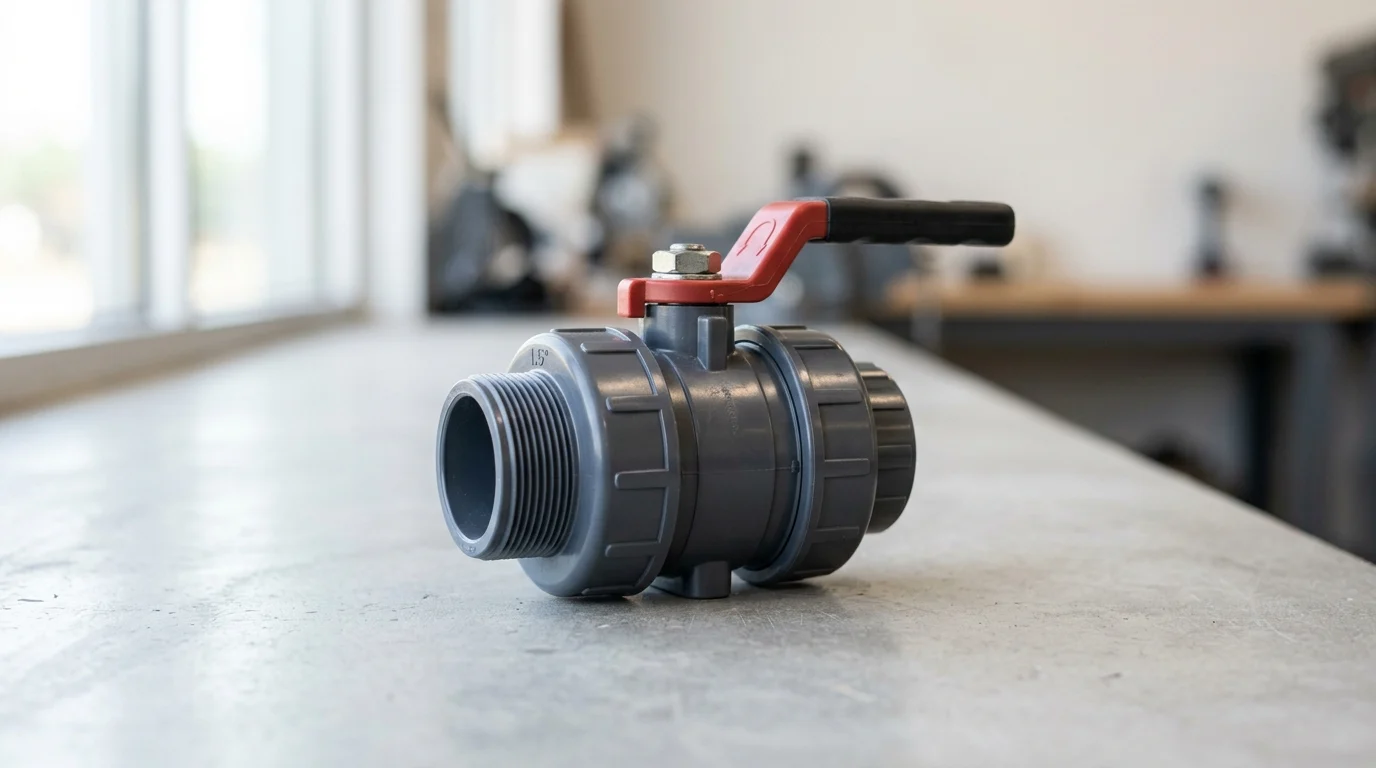
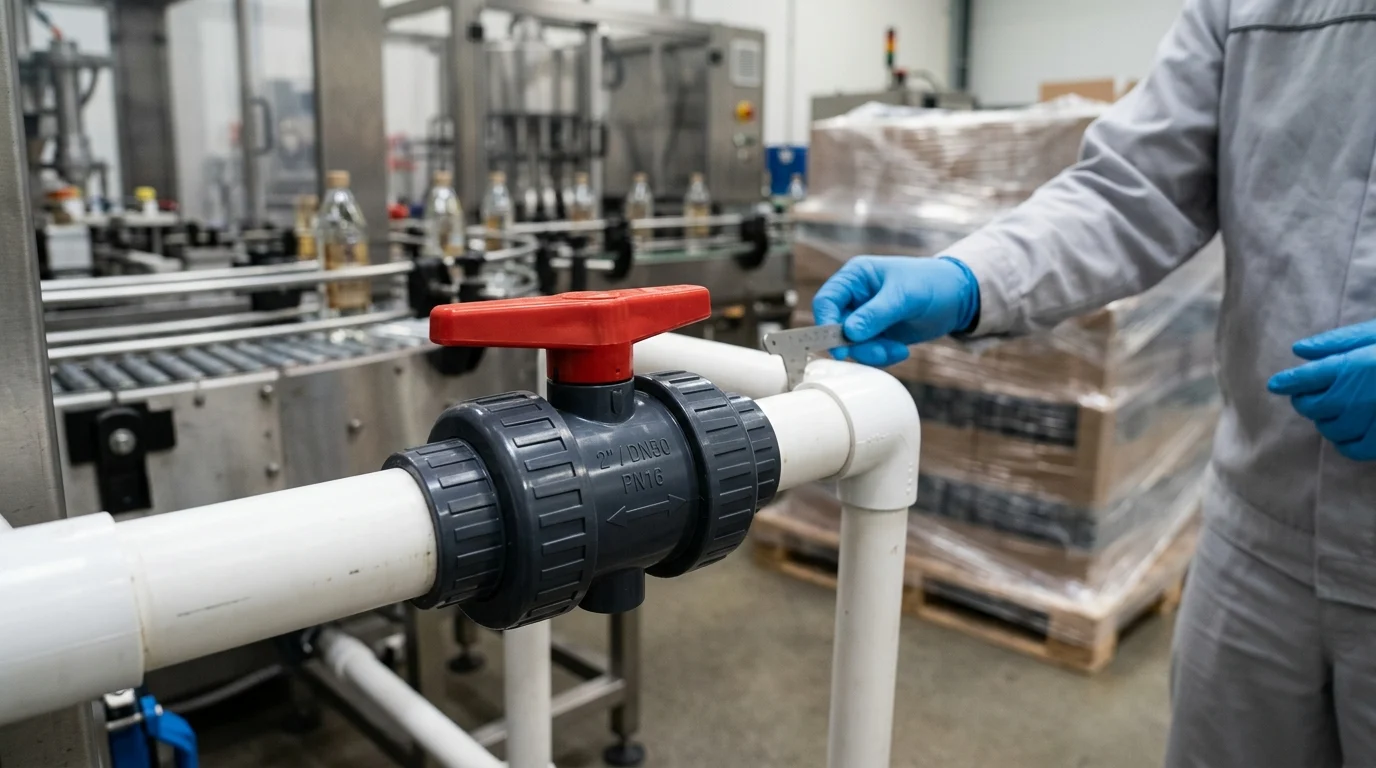
Industrial PVC ball valves are categorized into several structural types, each serving distinct operational requirements. Compact valves feature a unibody construction; they are economical but cannot be repaired inline. In contrast, true union valves incorporate threaded carrier nuts on both ends, allowing the central valve body to be removed from a pipeline without cutting the pipe. This design reduces maintenance labor by up to 75% during seat replacements or system cleanouts.
For automated processes, actuated PVC ball valves integrate pneumatic or electric actuators. These valves must feature an ISO 5211 mounting pad to ensure standardized alignment between the valve stem and the actuator drive. Specialized variations, such as vented ball valves, are required for volatile media like sodium hypochlorite; these feature a small port drilled into the ball to vent off-gassing chemicals upstream, preventing pressure entrapment that could otherwise shatter the valve.
PVC ball valve vs CPVC and metal valves
Selecting the appropriate material for an industrial pipeline requires an objective comparison between PVC, Chlorinated Polyvinyl Chloride (CPVC), and traditional metallic alloys. While PVC is highly versatile, recognizing its structural limitations relative to alternative materials is critical for ensuring system integrity and regulatory compliance.
Key comparison criteria
The most critical comparison criteria include maximum operating temperature, pressure thresholds, chemical resistance profiles, and relative acquisition costs.
| Material | Max Operating Temp | Max Pressure (at 73°F) | Relative Cost Factor | Acid Resistance (General) |
|---|---|---|---|---|
| PVC | 140°F (60°C) | 150 – 235 psi | 1.0x (Baseline) | Excellent |
| CPVC | 200°F (93°C) | 150 – 235 psi | 1.5x – 2.0x | Excellent |
| 316 Stainless Steel | >400°F (204°C) | 1000+ psi | 4.0x – 6.0x | Poor to Good (Media Dependent) |
| Carbon Steel | >400°F (204°C) | 1000+ psi | 2.5x – 4.0x | Poor |
As demonstrated, PVC offers the most cost-effective baseline for applications within its thermal and pressure constraints. CPVC provides a necessary upgrade for elevated temperatures up to 200°F, while metals remain mandatory for high-pressure, high-temperature, or extreme mechanical stress environments.
Where PVC performs well and where it falls short
PVC excels in ambient-temperature applications involving highly corrosive inorganic chemicals, deionized water, and wastewater. Its smooth internal bore prevents scaling and biological buildup, making it ideal for municipal water treatment and chemical dosing skids. Furthermore, its lightweight nature—often one-sixth the weight of steel—significantly reduces structural support requirements and installation fatigue.
Conversely, PVC falls short in applications involving aromatic hydrocarbons, solvents, or compressed gases. The Occupational Safety and Health Administration (OSHA) strictly prohibits the use of standard PVC for transporting compressed air or gases, as the material can shatter into hazardous shrapnel upon failure. Additionally, standard PVC is susceptible to ultraviolet (UV) degradation; outdoor installations require UV-stabilized formulations, painting, or external insulation to prevent embrittlement.
Practical steps for selection, installation, and maintenance
A rigorous approach to specification, installation, and lifecycle management separates highly reliable fluid systems from those plagued by chronic leaks. Engineers and technicians must follow standardized protocols to maximize the operational lifespan of PVC ball valves.
Step-by-step valve selection process
The selection process must be systematic. Step one involves defining the exact chemical composition, concentration, and specific gravity of the media. Step two requires calculating the maximum anticipated system pressure and temperature, cross-referencing these figures against the manufacturer’s thermal derating curves.
Step three is determining the appropriate end connections. Socket fusion provides a permanent, leak-proof bond using solvent cement, while NPT threaded ends allow for disassembly but require careful torque management. Flanged connections, conforming to ANSI B16.5 dimensional standards, are typically reserved for integrating PVC valves into larger metallic piping networks or for valves exceeding 3 inches in diameter.
How to assess manufacturer quality and testing
Quality assurance varies significantly among PVC valve manufacturers. Industrial buyers should prioritize vendors that maintain ISO 9001 certified manufacturing facilities and offer products with third-party validations, such as NSF/ANSI 61 certification for potable water applications.
Testing protocols are a definitive indicator of quality. Reputable manufacturers subject 100% of their valves to a 1.5x hydrostatic shell test. For instance, a valve rated for 150 psi will be pressurized to 225 psi in the factory to verify structural integrity and seal performance before shipping. Requesting factory test certificates or material test reports (MTRs) is a standard best practice for critical industrial procurements.
Installation, inspection, and maintenance best practices
Installation errors account for a vast majority of thermoplastic valve failures. When installing threaded PVC valves, technicians must avoid overtightening; industry best practices dictate tightening only 1 to 2 turns past finger-tight. High-density PTFE tape should be used exclusively on threads, as liquid pipe dopes often contain chemical solvents that attack and degrade the PVC polymer chain.
Maintenance should be proactive. Even in isolation applications, PVC ball valves should be cycled (fully opened and closed) at least once every 6 months to prevent the PTFE seats from cold-flowing and locking the ball in place. Regular visual inspections should check for micro-cracking around the union nuts, which indicates excess pipeline stress or improper alignment during installation.
How industrial buyers should make the final decision
Finalizing the procurement of PVC ball valves requires synthesizing technical specifications with commercial realities. Industrial buyers must utilize structured decision-making frameworks to ensure the selected hardware meets both engineering tolerances and supply chain constraints.
Decision matrix for technical fit and compliance
To eliminate ambiguity during the specification phase, procurement teams should utilize a technical decision matrix that establishes strict operational thresholds.
| Parameter | Maximum Threshold for PVC | Alternative if Threshold Exceeded |
|---|---|---|
| Fluid Temperature | 140°F (60°C) | Specify CPVC or PVDF |
| System Pressure | 150 psi (at ambient) | Specify Metal or FRP lined valves |
| Media Chemistry | Inorganic acids/bases | Check compatibility; use Metal/PTFE for solvents |
| Pipeline Vibration | Low to Moderate | Use Metal or add extensive piping supports |
| Actuation Needs | Standard ISO 5211 | Specify metal brackets and precision couplings |
If any single parameter exceeds the established threshold for PVC, the buyer must escalate the material specification. This matrix approach ensures compliance with industrial safety standards and prevents the costly misapplication of thermoplastic components in severe service environments.
Final specification and purchasing guidance
When transitioning from specification to purchasing, buyers must consider Minimum Order Quantities (MOQs), logistical lead times, and inventory standardization. Standard-sized PVC ball valves (1/2-inch to 2-inch diameters) typically ship within 1 to 2 weeks. However, larger flanged valves (up to 8 inches) or specialized actuated assemblies may carry extended lead times of 6 to 8 weeks, requiring proactive supply chain planning.
Ultimately, industrial facilities benefit from standardizing on one or two highly reputable valve brands across the entire plant. This consolidation strategy streamlines maintenance training, ensures uniform installation protocols, and can reduce spare parts holding costs by 15% to 20%. By demanding rigorous technical documentation and aligning procurement with calculated lifecycle metrics, buyers can secure fluid control systems that deliver decades of reliable service.
Key Takeaways
- The most important conclusions and rationale for PVC ball valve
- Specs, compliance, and risk checks worth validating before you commit
- Practical next steps and caveats readers can apply immediately
Frequently Asked Questions
How do I choose the right PVC ball valve size for an industrial line?
Match the valve to pipe size, pressure class, and target flow. Also check fluid velocity stays below about 1.5 m/s in PVC systems to reduce water hammer risk.
When should I choose EPDM seals instead of FPM seals?
Use EPDM for water, diluted chemicals, bases, and ketones. Choose FPM for oils, hydrocarbons, and many strong acids after confirming chemical compatibility.
Why does temperature matter so much for PVC ball valves?
PVC pressure capacity drops sharply as temperature rises. Always apply the manufacturer’s derating chart before selecting a valve for warm or hot media.
Is a true union PVC ball valve worth the higher cost?
Usually yes for industrial systems. True union designs make maintenance and replacement faster, reducing downtime and lowering total lifecycle cost.
Can Donsen PVC ball valves be used for irrigation and water treatment systems?
Yes, Donsen supplies PVC valve series for water supply, irrigation, and related piping applications. Confirm media, pressure, temperature, and seal material before ordering.