Introduction
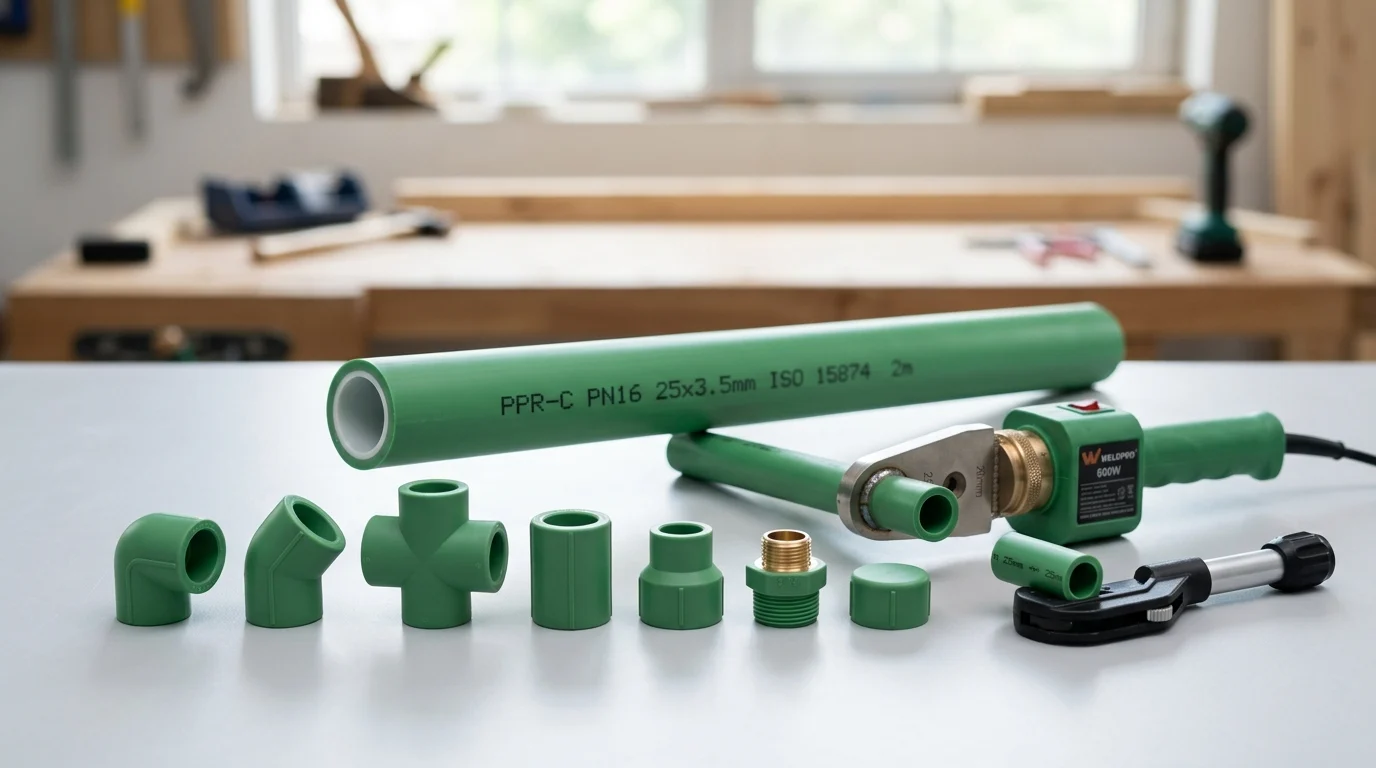
Selecting PPR pipe for a water supply system involves more than matching diameter and price. Material grade, pressure class, temperature performance, and joining method all affect durability, leak resistance, and long-term maintenance costs. This guide explains how PPR works in hot and cold water applications, what key specifications to compare, and where common selection mistakes can shorten service life. By the end, readers will have a practical framework for evaluating pipe quality, confirming suitability for operating conditions, and choosing a system that balances reliability, installation efficiency, and lifecycle value.
Why a PPR pipe guide matters for water supply
Polypropylene Random Copolymer (PPR) has fundamentally altered the landscape of modern fluid transport, establishing itself as a premier material for pressurized hot and cold water networks. As global infrastructure demands shift toward corrosion-resistant, low-maintenance materials, understanding the exact specifications and capabilities of PPR is critical for mechanical engineers, plumbing contractors, and procurement specialists.
A rigorous approach to selecting PPR pipe ensures structural integrity over an extended operational lifespan. When specified correctly, PPR infrastructure is engineered to deliver a continuous service life exceeding 50 years at operating temperatures of 70°C. However, achieving this longevity requires a comprehensive understanding of pressure ratings, material composition, and installation protocols.
Lifecycle cost and system reliability
The primary advantage of PPR piping systems lies in their thermal fusion joining process. Unlike mechanical fittings or solvent-welded joints, thermal fusion melts the pipe and fitting together at temperatures typically around 260°C, creating a homogeneous, monolithic material boundary. This eliminates microscopic leak paths and structural weak points that plague traditional systems.
Consequently, system reliability increases dramatically. Industry data indicates that properly fused PPR networks exhibit failure rates of less than 0.1% over a 20-year operational window. This high degree of reliability translates directly to a lower total cost of ownership (TCO), as maintenance and leak-remediation costs are functionally eliminated once the system passes its initial hydrostatic pressure test.
Residential, commercial, and industrial use cases
PPR’s chemical inertness and robust thermal properties make it suitable across a broad spectrum of environments. In residential construction, it serves as the backbone for potable water distribution and radiant heating loops. Commercial applications frequently leverage PPR for HVAC chilled water lines, capitalizing on the material’s low thermal conductivity to minimize condensation and insulation requirements.
In industrial settings, PPR is routinely deployed for compressed air networks, reverse osmosis (RO) water transport, and the conveyance of aggressive fluids. Depending on the Standard Dimension Ratio (SDR), industrial PPR systems can safely handle operating pressures up to 2.5 MPa (PN25), providing the mechanical strength necessary for demanding high-rise or heavy-duty manufacturing environments.
Technical factors to evaluate before choosing PPR pipe

Selecting the appropriate PPR pipe requires a technical evaluation of the system’s operational parameters against the pipe’s dimensional and material specifications. Engineers must calculate expected loads, peak temperatures, and flow velocities to ensure the selected pipe series will not experience premature degradation or catastrophic rupture.
Pressure class, temperature rating, and wall thickness
The structural capacity of a PPR pipe is dictated by its Standard Dimension Ratio (SDR), which represents the ratio of the pipe’s outer diameter to its wall thickness. A lower SDR indicates a thicker wall and, consequently, a higher pressure rating (PN). Specifying the correct SDR is the most critical step in balancing system safety with material cost efficiency.
| SDR | Pipe Series (S) | Nominal Pressure (PN) | Typical Application |
|---|---|---|---|
| SDR 11 | S 5 | PN 10 | Cold water supply / Irrigation |
| SDR 9 | S 4 | PN 16 | Mixed water / Low-pressure hot water |
| SDR 7.4 | S 3.2 | PN 20 | Standard hot water supply |
| SDR 6 | S 2.5 | PN 25 | High-pressure hot water / HVAC risers |
For example, a domestic cold water line may safely utilize an SDR 11 pipe, whereas a commercial hot water riser subjected to 65°C and significant static head pressure will require an SDR 6 or SDR 7.4 specification to maintain a sufficient safety factor over decades of continuous use.
Flow performance, thermal expansion, and joint integrity
PPR pipes offer exceptional hydraulic efficiency. Their highly smooth interior surface yields a Hazen-Williams C-factor of 150, which significantly reduces friction loss compared to metallic alternatives. This allows engineers to downsize pumps, reducing both capital expenditure and ongoing energy consumption.
However, thermal expansion is a critical engineering challenge. Standard homogenous PPR has a linear thermal expansion coefficient of approximately 0.15 mm/m°C. In a 50-meter straight hot water run experiencing a 40°C temperature differential, the pipe will expand by 300 mm. Proper integration of expansion loops, precise anchor point placement, and engineered slide guides are mandatory to prevent joint stress and pipe buckling.
When to choose reinforced PPR or alternatives
To mitigate the high thermal expansion of standard PPR, manufacturers developed composite alternatives, most notably fiberglass-reinforced PPR (PPR-FR or PPR-CT). By co-extruding a middle layer of glass fiber blended with PPR, the linear thermal expansion coefficient drops drastically to approximately 0.035 mm/m°C—a 75% reduction.
Reinforced PPR should be the default specification for long, straight runs of hot water piping, exposed exterior installations, and high-temperature HVAC applications. While the material cost is typically 15% to 25% higher than standard PPR, the savings achieved by requiring fewer expansion loops and support brackets often offset the initial premium.
How PPR compares with PVC, CPVC, copper, and PE
Material selection in mechanical engineering is rarely absolute; it is an exercise in weighing trade-offs. While PPR has captured significant market share, it competes directly with traditional metals like copper and other polymers such as PVC, CPVC, and PEX. A comparative analysis ensures the selected material aligns with the project’s budget, timeline, and physical constraints.
Key comparison criteria for material selection
When comparing piping materials, specifiers must look beyond basic pressure ratings to evaluate joint integrity, thermal resistance, and installation methodologies. The table below outlines the primary comparative metrics across leading water supply materials.
| Material | Joining Method | Max Operating Temp | Thermal Conductivity (W/m·K) | Relative Material Cost |
|---|---|---|---|---|
| Standard PPR | Thermal Fusion | 70°C (Continuous) | 0.24 | Moderate |
| CPVC | Solvent Cement | 93°C | 0.14 | Moderate to High |
| Copper | Soldering / Press | 100°C+ | 400.0 | Very High (3x-4x) |
| PEX | Mechanical Crimp | 90°C | 0.40 | Moderate |
Cost, durability, installation, and maintenance trade-offs
From a financial perspective, copper presents a massive hurdle; it is generally 3 to 4 times more expensive than PPR in raw material costs, and its pricing fluctuates significantly with global commodities markets. Furthermore, copper is susceptible to pitting corrosion in areas with aggressive water chemistry, whereas PPR is entirely immune to scaling and electrochemical corrosion.
Compared to CPVC, PPR offers significant installation advantages. CPVC relies on solvent cements that emit volatile organic compounds (VOCs) and require curing times up to 24 hours before the system can be fully pressurized. In contrast, a PPR thermal fusion joint cures in minutes and can be hydrostatically tested almost immediately. However, CPVC remains advantageous in tight retrofit spaces where bulky thermal fusion welding tools cannot easily reach.
Procurement, compliance, and quality control checks
Procuring PPR pipe at a commercial or industrial scale introduces variables related to quality assurance and supply chain management. Because PPR visually appears similar across different manufacturers, rigorous compliance checks and vetting processes are required to prevent substandard, off-spec materials from entering the construction site.
Standards, certifications, and potable water compliance
Authentic, high-grade PPR must comply with stringent international standards. The primary dimensional and performance framework is dictated by ISO 15874 and DIN 8077/8078. For potable water applications, the material must pass rigorous health and safety testing, such as NSF/ANSI 61 or WRAS certifications, to ensure no heavy metals, plasticizers, or toxic compounds leach into the drinking water.
Buyers should demand raw material traceability. Premium PPR pipes are extruded from 100% virgin polypropylene random copolymer sourced from reputable petrochemical suppliers. Cheaper alternatives often blend recycled regrind material into the extrusion process, which severely compromises the pipe’s pressure resistance and thermal stability.
Manufacturer review and fittings compatibility
Fittings compatibility is a major vulnerability in PPR networks. Because different manufacturers use slightly different proprietary blends of virgin resin, the Melt Flow Index (MFI) can vary. Fusing a pipe from Manufacturer A with a fitting from Manufacturer B can result in an uneven melt pool, leading to weak joints and eventual leaks.
Consequently, procurement teams must enforce a strict single-source policy for all pipes and fittings on a project. When ordering at scale, buyers should also be aware of typical Minimum Order Quantities (MOQs). For standard sizes, MOQs are usually low, but custom extrusions or specific reinforced series often require MOQs ranging from 3,000 to 5,000 meters.
Logistics, storage, and handling risks
PPR pipe is highly susceptible to ultraviolet (UV) degradation. Prolonged exposure to direct sunlight breaks down the polymer chains, causing the pipe to become brittle and lose its pressure-retaining capabilities. Logistics and storage protocols must mandate that PPR pipes are shipped in opaque packaging and stored indoors or under UV-blocking tarpaulins.
Temperature during handling is another critical risk factor. At temperatures below -5°C, PPR becomes highly brittle. If dropped or subjected to impact forces during winter logistics or site handling, micro-fractures can develop. These fractures are often invisible to the naked eye but will fail catastrophically during the initial pressure test. Strict cold-weather handling procedures must be enforced by site managers.
How specifiers and buyers should use this PPR pipe guide
Translating technical specifications and comparative data into a cohesive procurement strategy is the final step in leveraging PPR effectively. Specifiers must move systematically from fluid mechanics calculations to vendor qualification to ensure the final installation meets all design criteria.
A step-by-step decision process
The decision process should follow a rigid, step-by-step methodology. First, define the absolute maximum operating temperature and pressure (e.g., 60°C at 4 bar continuous). Second, select the appropriate SDR and Pipe Series using manufacturer derating curves to guarantee a 50-year lifespan under those specific conditions.
Third, calculate the thermal expansion for all straight runs exceeding 5 meters to determine if standard PPR is sufficient or if fiberglass-reinforced PPR-CT is required. Finally, audit the prospective manufacturer’s documentation, verifying ISO certifications, independent laboratory testing, and the availability of a complete, single-brand fittings catalog.
Project scenarios where PPR is the best fit
PPR emerges as the undisputed best fit in project scenarios where longevity, water purity, and lifecycle costs are prioritized. High-rise residential domestic water systems benefit immensely from PPR’s leak-free fused joints hidden behind finished walls. Similarly, hospitals and laboratories rely on PPR to maintain pristine water quality without the risk of heavy metal leaching associated with aging metallic pipes.
Ultimately, the return on investment for PPR is maximized in institutional and commercial projects with a 20+ year horizon. By utilizing this guide to correctly specify pressure classes, mandate reinforced layers where necessary, and enforce strict single-source procurement, buyers and engineers can deliver highly efficient, maintenance-free fluid transport networks.
Key Takeaways
- The most important conclusions and rationale for PPR pipe guide
- Specs, compliance, and risk checks worth validating before you commit
- Practical next steps and caveats readers can apply immediately
Frequently Asked Questions
What makes PPR pipe a good choice for water supply?
PPR resists corrosion, handles hot and cold water, and uses heat fusion joints that reduce leak risks. Properly selected systems can serve for over 50 years.
Which PPR pressure class should I choose for water supply?
Use PN10 for cold water, PN16 for mixed or low-pressure hot water, PN20 for standard hot water, and PN25 for higher-pressure hot water or risers.
How are PPR pipes connected?
They are usually joined by thermal fusion at about 260°C, melting pipe and fitting into one sealed connection. This creates strong, leak-resistant joints when installed correctly.
Can Donsen provide matching fittings for a complete PPR system?
Yes. Donsen supplies PPR pipes plus couplings, elbows, tees, unions, adaptors, reducers, plugs, and stainless steel or copper transition fittings for water supply projects.
Where can PPR pipe be used besides residential plumbing?
PPR also works in commercial buildings, HVAC chilled water lines, floor heating, irrigation, RO water transport, and some industrial fluid systems when the pressure and temperature are suitable