Why OEM vs ODM PPR Pipe Manufacturing Matters
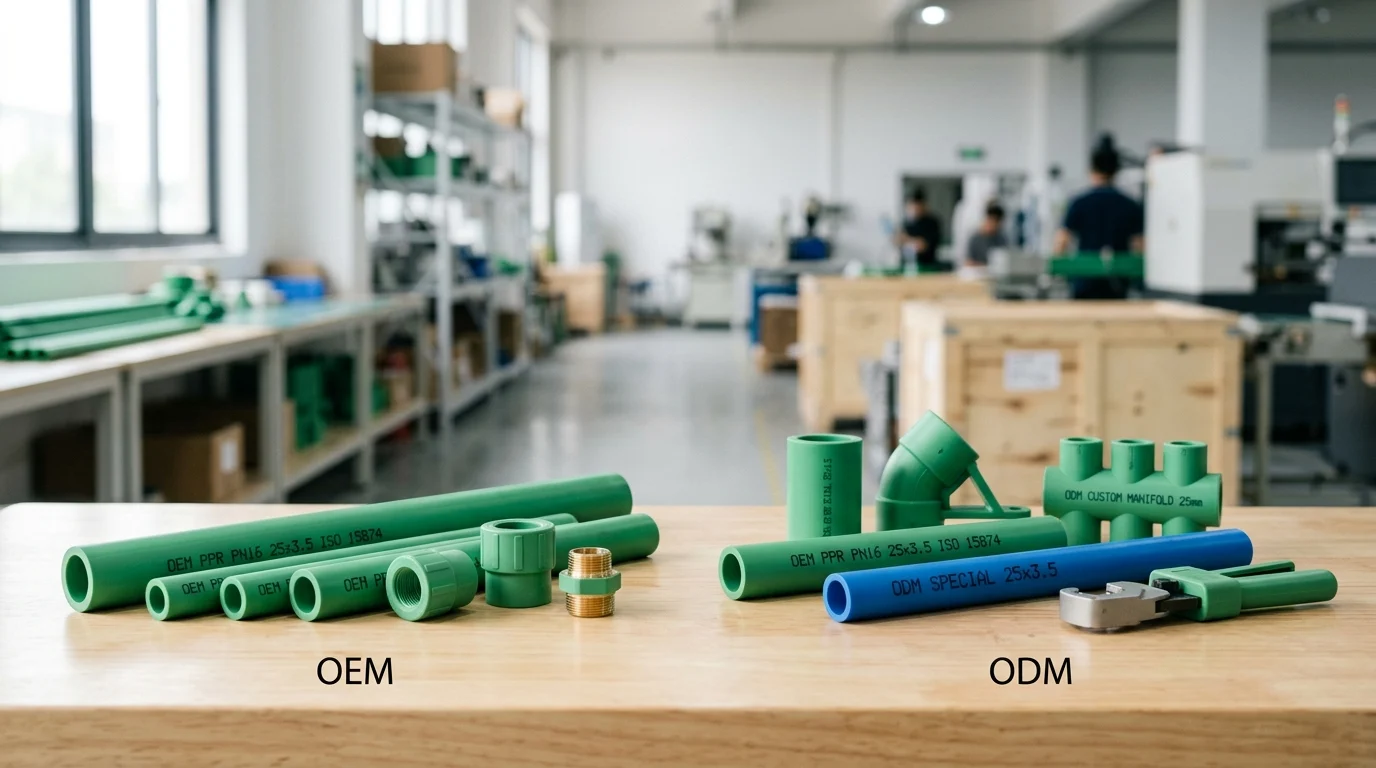
Procuring Polypropylene Random Copolymer (PPR) pipes for international distribution or large-scale construction requires navigating a complex global supply chain. At the center of this procurement strategy is the choice between Original Equipment Manufacturer (OEM) and Original Design Manufacturer (ODM) production models. This decision dictates not only the upfront capital expenditure but also the long-term strategic positioning of the buyer’s brand in the competitive plumbing and HVAC markets.
With the global PPR pipe market expanding steadily, driven by urbanization and the replacement of legacy metal piping systems, distributors and project managers must optimize their sourcing models. Selecting the correct manufacturing partnership directly influences product margins, intellectual property security, and the ability to meet localized regulatory standards. Understanding the nuanced differences between OEM and ODM pathways is a mandatory prerequisite for optimizing a supply chain that handles high-volume polymer extrusions.
How each model affects brand control
The selected manufacturing model fundamentally alters how a brand interacts with its target market. Under an OEM agreement, the buyer retains absolute control over the intellectual property, product specifications, and brand identity. This allows distributors to mandate proprietary color formulations, specific ultraviolet (UV) resistance additives, or unique wall thickness dimensions (such as standard dimension ratio, or SDR, profiles) that differentiate their product from commodity alternatives.
Conversely, the ODM model inherently limits brand control to surface-level aesthetics. Buyers typically apply their logo and packaging to a pre-engineered product. While this accelerates market entry, it means the distributor is selling the exact same physical pipe as potentially dozens of competitors, relying solely on marketing, distribution networks, and customer service to capture market share rather than proprietary technical advantages.
Key commercial risks for distributors
Distributors face distinct commercial risks depending on their chosen sourcing route. In the ODM framework, the primary risk is commoditization. Because the factory owns the design, they can legally sell the same standard PPR pipes to rival distributors within the same geographic region. Furthermore, ODM minimum order quantities (MOQs) are generally lower—often around 5,000 to 10,000 meters per size—which lowers financial risk but increases the likelihood of market saturation by smaller competitors.
OEM models present a different set of commercial hazards, primarily centered around capital allocation and supply chain rigidity. Developing custom extrusion dies and injection molds for a full range of PPR fittings requires substantial upfront investment. Furthermore, OEM contracts typically demand much higher MOQs, frequently exceeding 30,000 to 50,000 meters per production run to justify the factory’s setup time. If the customized product fails to gain market traction, the distributor is left with highly specific, illiquid inventory and unrecoverable tooling costs.
Core Differences Between OEM and ODM PPR Pipes
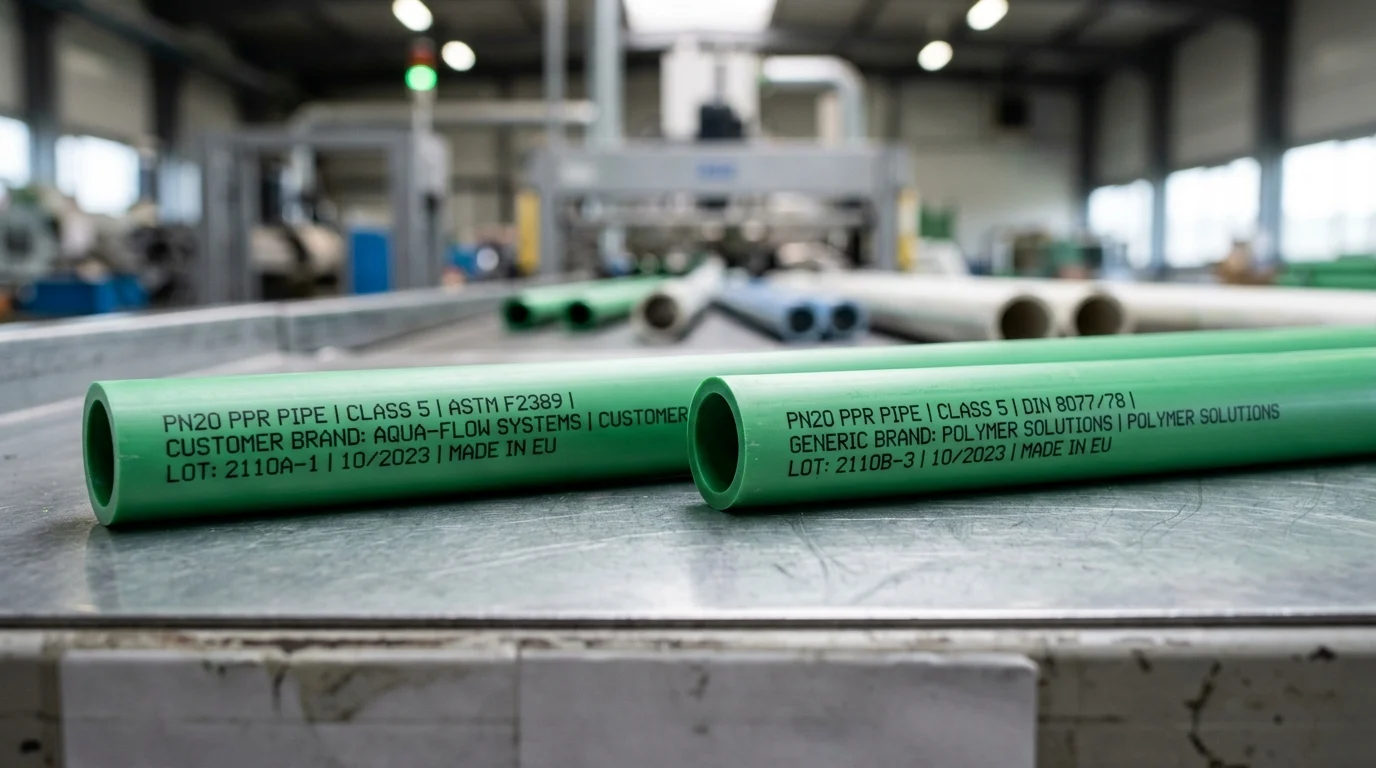
While both models result in the delivery of branded PPR piping systems, the division of labor, research and development (R&D) responsibilities, and intellectual property ownership differ drastically. Evaluating these core operational mechanics is essential for aligning procurement strategies with overarching corporate capabilities.
What OEM PPR pipe manufacturing means
OEM PPR pipe manufacturing is a contract manufacturing arrangement where the factory produces goods based entirely on the buyer’s proprietary design and specifications. The buyer is responsible for all engineering, structural calculations, and material specifications. The manufacturer acts strictly as the executor, providing the raw material sourcing network, extrusion machinery, and labor.
In an OEM scenario for PPR pipes, a buyer might specify a multi-layer composite pipe featuring a proprietary fiberglass reinforced middle layer, designed to achieve a specific linear expansion coefficient (e.g., 0.035 mm/mK) that outperforms standard pipes. The buyer supplies the CAD drawings for the specific socket fusion fittings and dictates the exact grade of polypropylene resin to be utilized. The factory cannot legally use these specifications for any other client.
What ODM PPR pipe manufacturing means
ODM PPR pipe manufacturing, often referred to as “private labeling” or “white labeling,” shifts the R&D and engineering burden entirely to the factory. The manufacturer develops, tests, and certifies a standard range of PPR pipes and fittings. The buyer then selects from this existing catalog, requesting minor cosmetic modifications such as custom pipe colors, printed brand names along the pipe’s longitudinal axis, and customized packaging.
Because the manufacturer has already absorbed the tooling costs and optimized the extrusion process for these specific designs, the ODM model is highly efficient. A distributor can select a standard PN20 or PN25 pressure-rated pipe, apply their brand, and commence shipping without needing an in-house polymer engineering team.
OEM vs ODM comparison factors
To clarify the operational and financial distinctions, the following table contrasts the primary factors between OEM and ODM models in the context of PPR pipe production.
| Feature/Metric | OEM (Original Equipment Manufacturer) | ODM (Original Design Manufacturer) |
|---|---|---|
| Design Ownership | Buyer | Manufacturer |
| R&D Investment | High (Borne by Buyer) | Low (Borne by Manufacturer) |
| Tooling/Mold Costs | Paid by Buyer ($1,000 – $5,000+ per mold) | Absorbed by Manufacturer |
| Time to Market | 3 to 6 months (Includes prototyping) | 2 to 4 weeks (Standard production) |
| Typical MOQ | High (e.g., 30,000m+ per specification) | Low to Medium (e.g., 5,000m – 10,000m) |
| Product Differentiation | High (Proprietary features) | Low (Cosmetic branding only) |
This comparison highlights that OEM is inherently a high-barrier, high-reward strategy suited for established enterprises, whereas ODM provides agility and capital efficiency for distributors prioritizing rapid inventory turnover.
Technical and Quality Factors to Evaluate
Regardless of whether a buyer opts for OEM or ODM, the technical integrity of the PPR piping system is non-negotiable. Failures in pressurized plumbing or hydronic heating systems result in catastrophic water damage and severe liability. Consequently, rigorous evaluation of the manufacturer’s technical capabilities and quality assurance frameworks is a critical phase of supplier selection.
Raw materials, pressure ratings, and pipe dimensions
The foundation of any high-quality PPR pipe is the virgin polymer resin. Top-tier manufacturers utilize recognized Type 3 Polypropylene Random Copolymer resins, such as Borealis RA130E or Hyosung R200P. The use of regrind or recycled plastics drastically reduces the pipe’s hydrostatic strength and thermal stability. Buyers must verify the exact material data sheets (MDS) and ensure the factory has the capability to extrude standard metric dimensions, typically ranging from 20mm to 160mm in outer diameter.
Pressure ratings must strictly align with the intended application. PPR pipes are generally classified by their Nominal Pressure (PN) or Standard Dimension Ratio (SDR). For instance, a PN10 (SDR 11) pipe is suitable for cold water distribution, while a PN20 (SDR 6) or PN25 pipe is required for centralized hot water systems operating at elevated temperatures. In an OEM agreement, buyers can specify custom wall thicknesses to achieve unique safety factors, whereas ODM buyers must select from the factory’s pre-validated SDR profiles.
Testing and certification requirements
Compliance with international standards is the primary mechanism for mitigating liability. At a minimum, the manufactured pipes must comply with DIN 8077/8078 (German standards for PP pipes dimensions and general quality requirements) and ISO 15874 (international standard for plastics piping systems for hot and cold water installations).
Verification requires reviewing third-party laboratory test reports. Critical tests include the hydrostatic pressure test, where pipes are subjected to internal pressure at 95°C for 1,000 hours to ensure they do not rupture. Additional certifications, such as WRAS (UK), NSF 14/61 (USA), or DVGW (Germany), may be legally required depending on the target market. ODM products usually carry the factory’s certifications, while OEM products require the buyer to fund and undergo a new certification process for their proprietary design.
Factory quality management systems
A robust Quality Management System (QMS) ensures batch-to-batch consistency. The factory should hold an active ISO 9001 certification, but buyers must look beyond the certificate to the actual shop floor practices. Effective QMS in polymer extrusion involves automated inline laser micrometers to continuously monitor wall thickness and outer diameter deviations in real-time.
Furthermore, buyers should inquire about the factory’s defect tracking and traceability protocols. A world-class PPR pipe manufacturer targets a defect rate of less than 0.15%. Every meter of pipe should be printed with a timestamp, machine identifier, and batch code, allowing the manufacturer to trace any field failures back to the specific hour of production and the exact batch of raw resin utilized.
Cost, Lead Time, Logistics, and Supplier Management
Executing a successful import strategy for PPR pipes requires more than just technical alignment; it demands rigorous financial and logistical planning. The transition from product conceptualization to landed inventory involves managing complex cost structures, realistic production timelines, and comprehensive supplier auditing.
Key cost drivers, including mold investment
The unit cost of a PPR pipe is primarily dictated by the current commodity price of polypropylene resin, which accounts for approximately 70% to 80% of the total manufacturing cost. Additional cost drivers include energy consumption during extrusion, labor, and the specific additives required (e.g., UV stabilizers or antimicrobial compounds). When negotiating, buyers must understand whether the quoted price is based on FOB (Free On Board) or EXW (Ex Works) terms.
For OEM projects, mold investment is a significant upfront capital expenditure. While extrusion dies for straight pipes are relatively inexpensive, injection molds for complex brass-insert fittings (such as threaded elbows or tees) require precision engineering. A single high-quality steel mold for a 25mm female threaded elbow can cost between $1,500 and $4,500, depending on the number of cavities and the steel grade (e.g., P20 or S136). A comprehensive OEM product line can easily require $50,000 to $100,000 in initial tooling investments.
Production scheduling and sample approval
Production lead times vary significantly between the two models. For an ODM order, assuming the raw materials are in stock, standard production scheduling generally requires 15 to 25 days from the receipt of the initial deposit. This timeline includes the time required to configure the extrusion line, print the customized brand markings, and complete final quality control inspections before container loading.
OEM scheduling is vastly more complex. Before mass production can begin, the factory must manufacture the custom molds, which typically takes 30 to 45 days. Following mold completion, T1 (first trial) samples are produced and shipped to the buyer for physical and dimensional approval. Iterative adjustments may be required, adding several weeks to the timeline. Consequently, an initial OEM production run often requires 60 to 90 days from contract signature to shipment.
Supplier due diligence steps
Conducting thorough supplier due diligence is the most effective way to prevent supply chain disruptions. Distributors should avoid relying solely on digital storefronts and instead commission third-party factory audits via agencies like SGS, TUV, or Intertek. These audits verify the factory’s actual production capacity (e.g., confirming they can process 40 tons of resin per day) and ensure they possess the necessary export licenses.
Financial stability is another critical metric. Buyers should request business registration documents and verify the manufacturer’s registered capital and years in operation. Assessing their existing export markets provides insight into their familiarity with regional quality expectations. A factory successfully exporting large volumes to highly regulated markets like Western Europe or North America generally indicates a higher baseline of quality control compared to a factory focused solely on domestic or unregulated markets.
How to Choose Between OEM and ODM PPR Pipes
The decision between OEM and ODM is not binary; it is a strategic choice dictated by a company’s current market position, available capital, and long-term growth objectives. Selecting the optimal path requires an objective analysis of internal capabilities versus external market demands.
Decision framework based on business goals
To systemize the decision-making process, procurement teams should evaluate their operational parameters against the inherent strengths of each manufacturing model. The following matrix outlines the optimal scenarios for selecting OEM versus ODM.
| Business Parameter | Lean Toward ODM | Lean Toward OEM |
|---|---|---|
| Available Capital | Under $30,000 | Over $100,000 |
| Time constraints | Launch needed in < 60 days | Launch flexible (4-6 months) |
| Engineering Capacity | None / Limited | Dedicated in-house engineers |
| Market Strategy | Price competition & volume | Premium positioning & unique features |
| Target Volume | Low to Moderate (LCL or 1-2 FCL) | High Volume (Multiple FCLs monthly) |
By applying this framework, distributors can prevent the common pitfall of overextending capital on OEM tooling before establishing a viable sales channel, or conversely, suffering margin compression by utilizing generic ODM products in a highly sophisticated market.
When OEM is better for differentiation
OEM is the superior choice for established brands seeking to dominate a specific niche or command premium pricing. When a distributor has a mature sales network and deep localized knowledge, they can identify specific deficiencies in existing products. By leveraging OEM, they can engineer solutions—such as a proprietary multi-layer PPR pipe with an integrated oxygen barrier specifically optimized for advanced hydronic heating systems.
Furthermore, OEM is necessary for large-scale industrial or municipal projects that require strict adherence to bespoke architectural specifications. In these scenarios, the ability to control the dimensional tolerances, specify exact resin grades, and own the intellectual property justifies the heavy capital expenditure and extended lead times. The ROI timeline for OEM investments typically spans 18 to 24 months, requiring a long-term strategic outlook.
When ODM is better for faster launch
ODM is the optimal pathway for new market entrants, regional hardware distributors, and companies looking to rapidly expand their product catalog without assuming technical risk. If a distributor’s primary competitive advantage is their logistics network, localized customer service, or aggressive pricing strategy, dedicating capital to reinventing a standard plumbing pipe is highly inefficient.
By choosing ODM, a business can allocate its capital toward marketing, inventory depth, and sales channel acquisition rather than steel molds and R&D. It allows a company to procure high-quality, certified PN25 pipes, brand them cohesively, and begin generating revenue within weeks. As the brand matures and volume dictates, the business can strategically transition specific high-margin SKUs from ODM to OEM, scaling their supply chain sophistication in tandem with their market share.
Key Takeaways
- Choose OEM PPR manufacturing when your brand needs proprietary specifications, stronger IP control, and technical differentiation in competitive plumbing or HVAC markets.
- Use ODM manufacturing when speed, lower upfront investment, and standard product availability matter more than exclusive design ownership.
- Plan MOQ and cash flow carefully because ODM runs may start around 5,000 to 10,000 meters per size, while OEM runs can exceed 30,000 to 50,000 meters.
- Reduce sourcing risk by confirming SDR profiles, pressure ratings, additives, fitting compatibility, packaging, and local compliance requirements before production.
- Work with experienced pipeline suppliers that offer broad product systems, such as PPR pipes, fittings, plastic valves, and application-specific solutions for water supply, drainage, irrigation, and floor heating.
Frequently Asked Questions
What is the main difference between OEM and ODM PPR pipe manufacturing?
OEM uses the buyer’s specifications, tooling, and brand requirements, giving stronger control over design and IP. ODM uses the manufacturer’s existing pipe design, allowing faster launch and lower development cost but less product differentiation.
When should a distributor choose OEM PPR pipes?
Choose OEM when you need proprietary specifications, unique colors, special SDR profiles, branded fittings, or stronger market differentiation. It is best for established buyers that can handle higher tooling costs and larger production runs.
When is ODM a better option for PPR pipe sourcing?
ODM is better for faster market entry, lower upfront investment, and standard product ranges. It suits buyers testing a market or building volume before committing to custom molds, dies, or exclusive technical specifications.
How do MOQs usually differ between OEM and ODM PPR production?
ODM minimum order quantities may be around 5,000 to 10,000 meters per size, while OEM runs can exceed 30,000 to 50,000 meters because custom setup, tooling, and extrusion planning require higher volume.
What commercial risks should PPR pipe buyers compare?
ODM risks include commoditization and competitors selling similar products. OEM risks include higher capital investment, tooling costs, and slower product changes if demand shifts or the customized range does not gain traction.