How PP Compression Fittings Improve Irrigation Efficiency
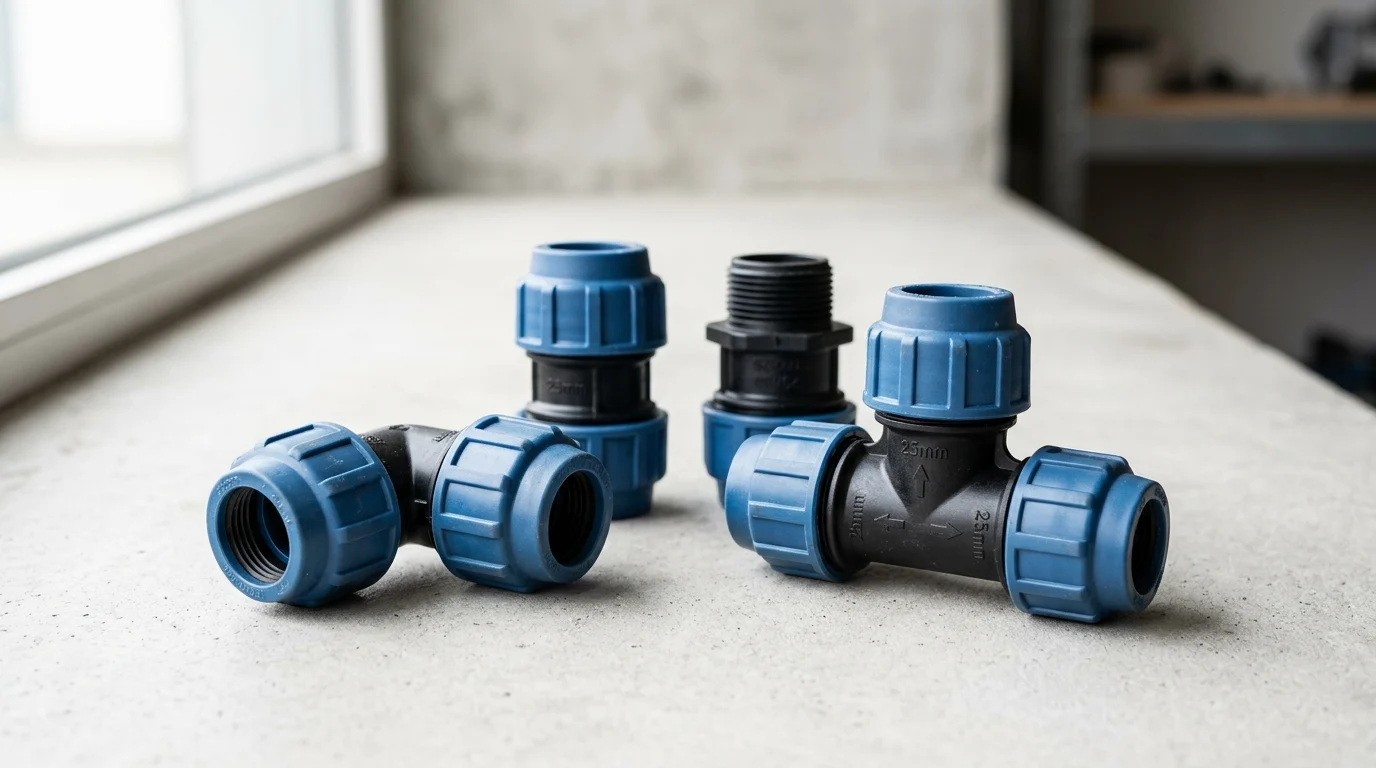
Modern agricultural irrigation systems require robust pipelines that can handle continuous environmental and mechanical stress. Polypropylene (PP) compression fittings, typically available in diameters ranging from 16mm to 110mm, have become a critical component in these networks. Manufacturers design them specifically to join high-density polyethylene (HDPE) and low-density polyethylene (LDPE) pipes without thermal fusion or solvent welding. By using a mechanical interference fit, these fittings create a secure, watertight seal that boosts the overall efficiency of agricultural water distribution.
The need to optimize agricultural water usage drives the shift toward PP compression technology. Large-scale farming operations must maintain precise water flow. PP compression fittings stabilize this infrastructure by reducing pressure drops and eliminating structural weak points in the pipeline, helping farmers consistently meet their irrigation targets.
Why PP Compression Fittings Reduce Water Loss
Traditional irrigation networks often suffer from significant water loss. Industry estimates suggest that aging or poorly joined systems can lose up to 30% of their water to subsurface leaks before it ever reaches the lateral drip lines. PP compression fittings address this problem through a multi-component seal. When you tighten the nut, it compresses a polyacetal (POM) split ring that grips the outer wall of the polyethylene pipe. At the same time, it compresses a rubber O-ring against the pipe’s surface.
Field data indicates this dynamic sealing mechanism can reduce leakage rates to minimal levels (often <1% volumetric loss) under standard operational conditions. Because the rubber seal adapts to minor dimensional variations and slight pipe ovality, the joint remains watertight even during ground shifting or thermal expansion. By virtually eliminating water loss at junction points, farm operators maximize their pumping output, which supports higher crop yield potential by ensuring consistent water delivery.
How They Support Reliable Agricultural Irrigation
Reliable irrigation systems must maintain their structural integrity under fluctuating operational loads. Engineers design PP compression fittings to withstand severe hydraulic shocks, including the water hammer events that frequently occur during pump start-ups and valve closures. Premium fittings typically carry a rating for continuous operation at 16 bar (PN16) at 20°C. This provides a substantial safety margin for standard agricultural systems, which usually operate between 3 and 8 bar.
Furthermore, the smooth internal bore of PP fittings minimizes friction loss, supporting consistent flow rates across long pipe runs. This consistency is vital in precision agriculture—such as micro-sprinkler and pressure-compensated drip irrigation—where uniform water discharge is required. The robust mechanical grip prevents pipe pull-out even under high tensile loads, ensuring that joint failures do not interrupt critical irrigation cycles during peak growing seasons.
Important Limitations and Temperature Derating: While highly reliable for these applications, PP compression fittings require careful specification. They are generally not recommended for deep-buried municipal trunk lines where butt-fusion welding remains the standard. Additionally, pressure ratings are strictly tied to temperature; operating above 20°C requires applying a temperature derating factor (for example, a PN16 fitting may derate to approximately 10 bar at 40°C), meaning the maximum safe pressure decreases as water or environmental temperatures rise.
Key Technical Specifications to Evaluate
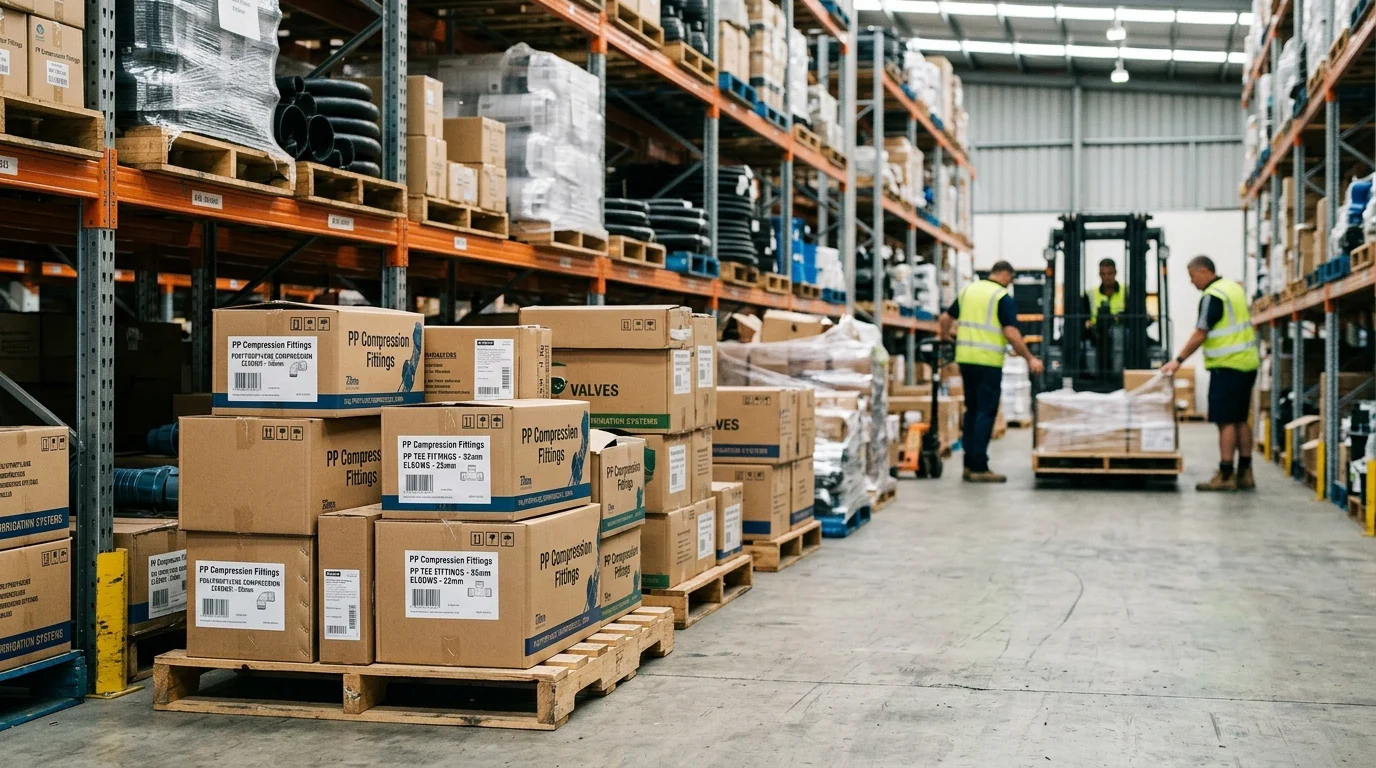
Evaluating PP compression fittings requires a careful look at their technical specifications to ensure they match your existing piping and environmental conditions. Buyers and engineers should scrutinize pressure ratings, material composition, and seal designs to guarantee long-term stability.
Pressure Rating, Pipe Compatibility, and Seal Design
The fundamental specification for any compression fitting is its Nominal Pressure (PN) rating. This dictates the maximum sustained internal pressure the joint can handle at a baseline temperature of 20°C. Manufacturers predominantly classify agricultural fittings as either PN10 or PN16. Selecting the right rating depends on where the fitting sits within the irrigation system.
Pipe compatibility is equally critical. You must match fittings to the exact outer diameter (OD) and Standard Dimension Ratio (SDR) of the PE pipe. High-quality PP fittings accommodate SDR 11 through SDR 17.6 pipes (covering typical wall thicknesses from 1.6mm to 10.0mm). The seal design—typically using Nitrile Butadiene Rubber (NBR) or Ethylene Propylene Diene Monomer (EPDM) O-rings—must provide high resilience and resist permanent deformation.
| Pressure Rating (PN) | Maximum Operating Pressure | Typical Agricultural Application |
|---|---|---|
| PN6 | 6 bar (87 psi) | Gravity-fed lines, low-pressure surface laterals |
| PN10 | 10 bar (145 psi) | Sub-mains, micro-irrigation distribution networks |
| PN16 | 16 bar (232 psi) | Mainlines, pump station manifolds, fertigation hubs |
UV Resistance and Chemical Durability
Agricultural fittings face harsh environmental factors, making ultraviolet (UV) resistance a non-negotiable feature for above-ground installations. Manufacturers produce premium PP compression fittings from Polypropylene Block Copolymer (PP-B). To protect against UV damage, they enrich this material with carbon black additives—industry standards often specify a concentration of 2.0% to 2.5%. This specific blend prevents the plastic from becoming brittle, supporting a 20- to 50-year service life under direct sunlight.
Chemical durability is just as important, particularly in modern fertigation systems that inject fertilizers, herbicides, and line-cleaning acids directly into the water supply. PP-B and EPDM seals offer broad-spectrum resistance to aqueous agricultural chemicals at fluid temperatures up to 40°C. They safely handle fluid solutions with pH levels ranging from 2.0 (highly acidic cleaning agents) to 10.0 (alkaline fertilizers) without cracking or swelling. However, it is crucial to note that EPDM generally performs poorly with oils and hydrocarbons, so its chemical resistance applies specifically to water-based agricultural additives.
Common Failure Modes to Check
Despite their robust design, PP compression fittings can fail if installers ignore specific technical limits. To prevent issues, watch for these common failure modes:
- Thread Stripping: This occurs when installers apply excessive torque. For instance, field guidelines often warn that applying more than 50 Nm of torque on fittings larger than 63mm can deform the nut’s trapezoidal threads. Always specify fittings with engineered thread profiles that distribute mechanical stress evenly.
- O-ring Displacement or Shearing: This typically happens when a technician inserts the PE pipe without proper chamfering. The sharp, unchamfered edge of the cut pipe can slice or push the rubber seal out of place.
- Regrind Weakness: Buyers must avoid fittings manufactured with high percentages of regrind (e.g., >5% recycled content). Recycled material severely compromises the tensile strength of the clinching ring, often leading to premature pipe pull-out under pressure.
Installation and Maintenance Benefits
Large-scale irrigation projects rely on minimizing the operational and capital expenditures associated with pipeline deployment. PP compression fittings introduce substantial economic advantages. They drastically streamline the installation process and reduce the frequency and complexity of ongoing system maintenance.
How They Reduce Labor During Installation
Electrofusion and butt-welding techniques require specialized heavy machinery, precise environmental conditions, and reliable electrical power in remote fields. In contrast, PP compression fittings are purely mechanical. Technicians can install them using basic hand tools—or entirely by hand for diameters up to 50mm. This eliminates the need for certified welding technicians and heavy equipment rentals, directly lowering labor costs.
Compression fittings also excel in deployment speed. A standard electrofusion joint on a 90mm pipe might require 10 to 15 minutes of preparation, heating, and cooling time. A PP compression joint of the same diameter can be fully secured in just 2 to 3 minutes. In an agricultural project requiring thousands of connections, saving this much time per joint accelerates project completion by weeks and reduces per-joint labor costs by an estimated 40% to 60%, allowing farmers to plant and irrigate earlier in the season.
How Leak Prevention Lowers Maintenance Costs
Repairing subsurface leaks and tractor-damaged laterals frequently consumes agricultural maintenance budgets. The compressed O-ring design prevents leaks and drastically lowers the baseline maintenance required to keep the system pressurized. When a blockage or damage does occur, the modularity of the compression fitting proves invaluable.
Unlike solvent-cemented or welded joints—which crews must cut out and discard—PP compression fittings are entirely demountable and reusable. If agricultural machinery crushes a section of PE pipe, maintenance crews simply unthread the fitting nuts, remove the damaged pipe segment, insert a new piece, and retighten the existing fitting. Industry case studies suggest this reusability can significantly reduce replacement fitting costs over a 10- to 20-year lifecycle, improving the overall return on investment. However, operators should be aware of seasonal decommissioning limits; while reusable, repeatedly disassembling and retightening the same fitting can eventually degrade the O-ring and clinching ring, typically requiring seal replacement after 3 to 5 assembly cycles.
Best Practices for Field Installation
To realize the full benefits of PP compression fittings, field technicians must follow strict installation protocols. While the assembly process is straightforward, skipping steps in pipe preparation, torque application, or system testing can compromise the pipeline.
Pipe Preparation, Insertion Depth, and Nut Tightening
A secure joint begins with precise pipe preparation. Technicians must cut the PE pipe at a perfect 90-degree angle. Angled cuts prevent the pipe from seating uniformly against the fitting’s internal stop, which creates turbulent flow and uneven pressure on the O-ring. After cutting, installers must chamfer the outer edge of the pipe—typically at a 15-degree angle—and deburr it. This ensures the pipe glides smoothly through the rubber seal without causing abrasions.
Insertion depth is another critical parameter. The installer must push the pipe past the clinching ring and the O-ring until it makes firm contact with the internal abutment. Once seated, tighten the nut to secure the joint. For pipe diameters up to 50mm, firm hand-tightening is generally sufficient. For larger diameters (63mm to 110mm), use specialized strap wrenches or dedicated compression fitting wrenches to apply the necessary torque without distorting the plastic nut.
| Pipe Diameter (mm) | Recommended Tightening Method | Typical Insertion Depth (mm) | Max Torque Guideline (Nm) |
|---|---|---|---|
| 16 – 32 | Manual (Hand-tight) | 40 – 55 | < 15 |
| 40 – 50 | Manual / Light Wrench | 60 – 75 | 15 – 30 |
| 63 – 110 | Strap Wrench / Dedicated Tool | 85 – 130 | 30 – 50 |
Inspection and Pressure Testing
Post-installation inspection and hydrostatic pressure testing are mandatory steps before burying mainlines or commissioning the system. Visual inspections should verify that no threads are cross-threaded and that the pipe aligns perfectly with the fitting axis to prevent lateral stress.
Always conduct hydrostatic pressure testing in accordance with industry standards. Standard protocols usually require testing the isolated pipeline section at 1.5 times the maximum designed operating pressure (for example, applying 15 bar to a system designed for 10 bar continuous operation). Maintain this pressure for a minimum of 1 hour (with an acceptable pressure drop threshold typically set at <2% over the test duration) so technicians can inspect all joints for micro-leaks or pressure drops. Never test with compressed air; pneumatic failures in thermoplastic pipes carry a severe explosive risk.
Matching Fittings to Irrigation System Layout
Designing an efficient field layout requires matching specific fitting geometries to their optimal locations. Using the correct configuration minimizes pressure loss and limits the number of joints required, reducing both costs and potential failure points. Use the following decision checklist to select the right fitting for your layout:
- Need to split high-volume flow evenly across parallel crop rows? Use Equal Tees or Crosses in the sub-main distribution zone.
- Need to step down pipe diameters to increase fluid velocity for emitters? Use Reducing Couplers at mainline-to-lateral transitions.
- Need to connect thermoplastic PE networks to metal valves and heavy pumps? Use Flanged Adaptors at pump stations and filtration hubs.
- Need to seal the end of drip lines while allowing for seasonal flushing? Use End Caps at the lateral terminus.
Selecting the appropriate transition fittings is particularly important when integrating new PE lines with legacy PVC or galvanized steel infrastructure. Use threaded female and male adaptors equipped with reinforced stainless steel rings wherever thermoplastic threads interface with metal counterparts. The metal reinforcement prevents the plastic from splitting under radial stress during tightening.
How Buyers Should Choose PP Compression Fittings
Procuring PP compression fittings for commercial-scale agricultural projects requires a strategic approach to supplier validation and quality assurance. Buyers must look beyond simple unit cost comparisons. Evaluate the material integrity of the products to ensure they meet the stringent demands of modern high-yield farming.
Sourcing, Certification, and Quality Checks
Sourcing reliable fittings means verifying that the manufacturer adheres to recognized international standards. Buyers should specify fittings certified under ISO 17885 (Plastics piping systems—Mechanical fittings for pressure piping systems). This certification guarantees the product has passed rigorous tests for internal pressure resistance, leak-tightness under bending, and resistance to pull-out. Additionally, the manufacturing facility should hold ISO 9001 certification to ensure consistent batch-to-batch quality.
Quality checks must also address material purity. Demand technical data sheets confirming the use of 100% virgin PP-B copolymer, as recycled (regrind) materials exhibit unpredictable mechanical properties. For large agricultural orders—where Minimum Order Quantities (MOQs) frequently exceed 10,000 units—buyers should negotiate acceptable defect rate thresholds in their Service Level Agreements (SLAs). A world-class supplier will typically target and guarantee exceptionally low defect rates (typically <0.1%, or 1,000 Parts Per Million), supported by standard production lead times of 3 to 5 weeks and pre-shipment inspection reports detailing dimensional tolerances and hydrostatic burst test results.
When PP Compression Fittings Are the Best Option
While PP compression fittings are highly versatile, buyers must correctly identify when they are the optimal engineering choice. PP compression technology is an excellent option for surface-laid, shallow-buried, and frequently modified PE pipe networks ranging from 16mm up to 110mm in diameter. Their ease of assembly makes them highly effective for dynamic agricultural environments where crop rotations and field layouts change seasonally.
However, buyers must weigh these benefits against specific trade-offs. For high-capacity municipal water mains or deep-buried permanent agricultural trunk lines exceeding 110mm (and up to 1200mm) in diameter, butt-fusion welding or flanged connections often become the standard due to the massive longitudinal forces at play and the need for absolute permanence. Ultimately, for the vast majority of in-field agricultural distribution—spanning sub-mains, manifold connections, and lateral drip line integration—PP compression fittings offer a balanced combination of technical reliability, installation speed, and cost-effectiveness. This secures their position as a highly practical solution for modern irrigation.
Key Takeaways
- Use PP compression fittings to join HDPE and LDPE irrigation pipes without thermal fusion or solvent welding, simplifying installation and field repairs.
- Specify correctly sealed compression joints to reduce leakage that can otherwise reach up to 30% in aging or poorly joined irrigation networks.
- Choose fittings with suitable pressure ratings, such as PN16 at 20°C, for agricultural systems that commonly operate between 3 and 8 bar.
- Select smooth-bore PP fittings to help minimize friction loss and maintain uniform discharge in drip and micro-sprinkler irrigation layouts.
- Account for temperature derating and application limits before using PP compression fittings in demanding or deeply buried pipeline systems.
Frequently Asked Questions
What are PP compression fittings used for in irrigation?
They mechanically join HDPE or LDPE irrigation pipes without heat fusion or solvent welding, creating watertight connections for mainlines, submains, and lateral distribution networks.
How do PP compression fittings reduce water loss?
A tightening nut compresses a split ring and rubber O-ring around the pipe, helping seal small surface variations and reducing leakage at joints under normal operating conditions.
What pipe sizes are common for PP compression fittings?
Agricultural PP compression fittings are commonly available from 16mm to 110mm, covering many drip, sprinkler, and farm water distribution applications.
Can PP compression fittings handle farm irrigation pressure?
Many premium fittings are rated PN16 at 20°C, while typical agricultural systems operate around 3 to 8 bar, giving a useful safety margin when correctly specified.
Do PP compression fittings help maintain consistent flow?
Yes. Their smooth internal bore can reduce friction loss and support stable flow across long pipe runs, which is important for drip irrigation and micro-sprinkler uniformity.