Introduction
Choosing between HDPE and PVC affects far more than material cost; it shapes leakage risk, installation methods, maintenance demands, and long-term network reliability. For water infrastructure projects, the better option depends on how each system performs under pressure, soil movement, trench conditions, and expected service life. This article compares HDPE and PVC through the factors that matter most to planners, engineers, and utility operators, including joint integrity, hydraulic performance, durability, and lifecycle value. By the end, readers will have a clearer framework for matching pipe material to project conditions rather than relying on broad assumptions or one-size-fits-all preferences.
Why HDPE vs PVC Pipe Systems Is a Strategic Decision
The selection between High-Density Polyethylene (HDPE) and Polyvinyl Chloride (PVC) pipe systems represents a foundational engineering decision that dictates the long-term viability of water infrastructure. As municipalities and private utilities face aging networks and stringent regulatory oversight, specifying the correct thermoplastic material requires moving beyond initial procurement costs to evaluate lifecycle performance, hydraulic efficiency, and geotechnical compatibility.
Capital planning, asset life, and network risk
Capital planning for water distribution networks hinges on maximizing asset life while minimizing operational expenditures. Modern water infrastructure projects typically demand a design life of 50 to 100 years. In this context, minimizing non-revenue water (NRW) is a primary financial objective. While the global average for NRW hovers around 30%, top-tier utility capital plans aim for NRW thresholds below 10%.
The choice between HDPE and PVC directly influences these metrics, as joint integrity, fatigue resistance, and maintenance requirements vary significantly between the two polymers over a multi-decade horizon. A misaligned material specification can lead to premature capital depletion through excessive leak repair programs and early asset replacement.
Project type, soil conditions, and pressure class
Project topology and soil mechanics dictate the baseline requirements for pipe material selection. Expansive clays, seismic zones, and areas prone to differential settlement exert severe bending moments and shear stresses on buried infrastructure. Furthermore, hydraulic modeling dictates the necessary pressure class to overcome elevation changes and friction losses.
Municipal water transmission lines often operate at sustained pressures of 100 to 150 psi, but engineers must specify materials capable of handling transient surges resulting from pump operations or valve closures. Standard AWWA classifications accommodate pressure ratings up to 305 psi for both materials, but their respective responses to cyclic fatigue and external soil loads necessitate a rigorous geotechnical and hydraulic analysis before finalizing the specification.
Material Performance Differences Between HDPE and PVC Pipe Systems
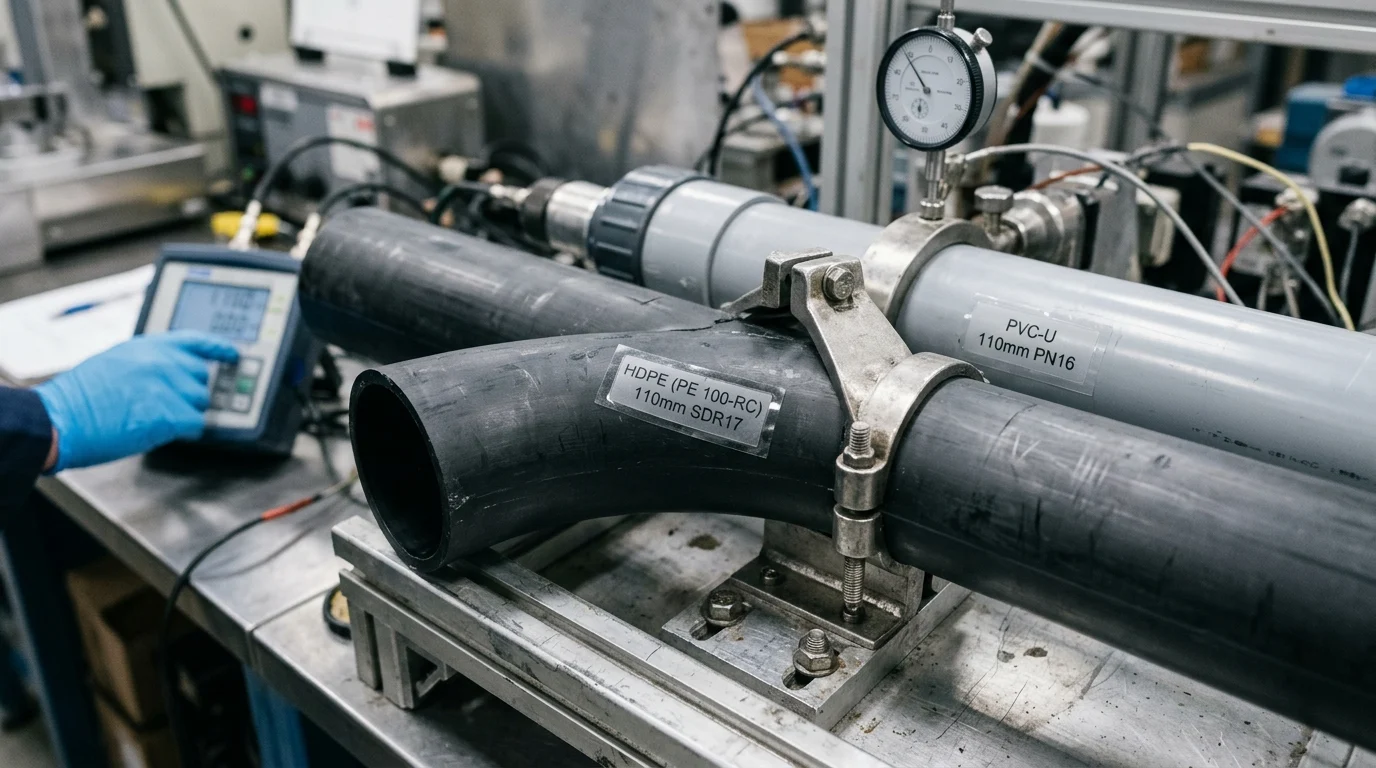
While both HDPE and PVC are engineered thermoplastics resistant to biological and chemical degradation, their molecular structures yield fundamentally different mechanical behaviors. Understanding these distinctions is critical for matching the pipe system to the specific demands of the hydraulic environment.
Flexibility, strength, and pressure capacity
The most pronounced mechanical difference lies in the balance of flexibility and tensile strength. PVC is a rigid material with a high short-term tensile yield strength of approximately 7,000 psi. This rigidity allows PVC to handle high internal pressures with thinner wall profiles, maximizing the internal flow area. Conversely, HDPE is highly ductile with a tensile yield strength closer to 3,000 psi, necessitating thicker walls (lower Dimension Ratios) to achieve equivalent pressure ratings.
However, this ductility grants HDPE an exceptional bend radius of 20 to 25 times the pipe diameter, allowing it to navigate sweeping curves without the need for manufactured elbows or heavy concrete thrust blocks, which are strictly required for rigid PVC installations to prevent joint separation at directional changes.
| Property | PVC (AWWA C900) | HDPE (AWWA C906) |
|---|---|---|
| Tensile Yield Strength | ~7,000 psi | ~3,000 psi |
| Flexibility / Bend Radius | Rigid (requires fittings) | 20 to 25x Pipe Diameter |
| Surge Tolerance (Occasional) | 1.6x Working Pressure | 2.0x Working Pressure |
| Joint Mechanism | Bell & Spigot (Gasketed) | Thermal Butt Fusion |
Corrosion resistance, leakage, and service life
Both materials offer exceptional resistance to tuberculation and external soil corrosion, effectively eliminating the need for the costly cathodic protection systems required by ductile iron mains. However, their joint configurations heavily influence the probability of long-term leakage and overall service life.
PVC relies on bell-and-spigot joints equipped with elastomeric gaskets. Over a 50-year service life, these gaskets can degrade, lose elasticity, or become dislodged due to pressure transients, creating potential leak paths. In contrast, HDPE utilizes thermal butt fusion, creating a monolithic pipeline where the joints are chemically equivalent to, or stronger than, the pipe itself. This seamless construction effectively eliminates joint leakage, a critical advantage in achieving a 100-year service life in high-stress environments.
Cost, Installation, and Logistics Factors for HDPE vs PVC
The economic viability of a pipeline project extends far beyond the factory gate price of the resin. A comprehensive cost analysis must incorporate installation methodologies, site logistics, and long-term maintenance expenditures to determine the true lifecycle cost of the infrastructure.
Material, installation, and lifecycle costs
In terms of direct material acquisition, PVC generally maintains a cost advantage, often pricing 15% to 30% lower per linear foot than HDPE of an equivalent pressure class. For straightforward open-cut trenching in stable soils, this upfront material savings makes PVC highly attractive to municipal procurement departments.
However, lifecycle costs often favor HDPE in complex urban environments. Because HDPE’s fused joints tolerate significant tensile pulling forces, it is the premier choice for trenchless installation methods like Horizontal Directional Drilling (HDD) and pipe bursting. Trenchless installations can reduce surface restoration costs and traffic disruption penalties by up to 50%, rapidly offsetting the higher initial material cost of the HDPE pipe and yielding a lower total installed cost.
Transportation, handling, storage, and contractor requirements
Logistics and contractor handling capabilities also diverge significantly based on the chosen material. PVC is typically shipped in standard 20-foot or 40-foot rigid lengths, requiring careful palletization and flatbed transport. While lightweight compared to metal pipes, PVC is susceptible to impact damage in cold weather and faces UV degradation limits; manufacturers typically recommend a maximum unprotected outdoor storage limit of 2 years before impact strength is compromised.
HDPE offers logistical versatility: diameters up to 6 inches can be delivered in continuous coils of up to 3,000 feet, drastically reducing shipping volume and field joint assembly time. Larger HDPE diameters are shipped in standard 40-foot to 50-foot sticks. The primary labor trade-off is that HDPE requires specialized thermal fusion equipment and certified welding technicians, whereas PVC can be assembled by standard utility crews using basic leverage tools and approved lubricants.
Standards, Compliance, and Risk Management for HDPE vs PVC Pipe
Mitigating operational risk requires strict adherence to industry standards and a thorough understanding of the failure mechanisms inherent to each thermoplastic material. Utility engineers must align their specifications with rigorous testing protocols to ensure public safety and network reliability.
Certification, testing, and utility specifications
Compliance frameworks in the North American market are governed primarily by the American Water Works Association (AWWA) and ASTM International. For potable water applications, both materials must possess NSF/ANSI 61 certification to verify that no harmful chemical leachates enter the drinking water supply.
Utility specifications typically mandate AWWA C900 for PVC pressure pipe and AWWA C906 for large-diameter HDPE installations. These standards dictate rigorous dimensional tolerances, hydrostatic pressure testing, and burst strength requirements. Furthermore, quality assurance programs must verify the resin’s cell classification, ensuring the polymer matrix meets baseline density and melt index thresholds before extrusion.
Failure modes, inspection, and maintenance risks
Risk management necessitates anticipating how and why these systems fail in the field. PVC is highly sensitive to point loading; a single sharp rock resting against the pipe in a poorly bedded trench can cause localized stress concentrations, leading to rapid crack propagation and catastrophic longitudinal failure. Strict adherence to trench bedding standards is mandatory to mitigate this risk.
HDPE is significantly more resilient to poor bedding but introduces risk during the fusion process. Cold welds, improper alignment, or contamination during thermal fusion can create weak joints that fail under pressure testing. Furthermore, to prevent oxidative degradation from UV exposure, HDPE must be manufactured with a minimum of 2% finely dispersed carbon black.
| Failure Mechanism | PVC Vulnerability | HDPE Vulnerability | Mitigation Strategy |
|---|---|---|---|
| Point Loading | High (leads to cracking) | Low (yields and deforms) | Strict bedding and backfill gradation (PVC) |
| Joint Separation | Moderate (gasket failure) | Zero (if fused correctly) | Thrust blocks for PVC; Certified welders for HDPE |
| Cyclic Fatigue / Surge | Moderate | Low | Utilize surge arrestors; specify higher pressure class |
| UV Degradation | Moderate (embrittlement) | Low (protected by 2%+ carbon black) | Tarping during prolonged storage |
Decision Framework for Choosing HDPE vs PVC Pipe Systems
Selecting the optimal pipe system is not a matter of declaring one material universally superior, but rather applying a systematic decision framework to match material capabilities with specific project parameters.
Step-by-step evaluation process
The evaluation process begins with a hydraulic transient analysis. Engineers must calculate the maximum anticipated surge pressures; HDPE accommodates occasional surges up to 2.0 times the working pressure, whereas PVC is typically limited to 1.6 times. Step two involves a geotechnical survey to assess soil stability, seismic risk, and groundwater levels.
Step three evaluates the installation environment, determining if open-cut trenching is feasible or if urban density mandates trenchless HDD. Finally, a net present value (NPV) lifecycle cost analysis must be conducted. This analysis should factor in a 50-to-100-year horizon, anticipated leak repair frequencies, pumping energy costs associated with internal diameters, and end-of-life replacement expenditures.
When HDPE is the better choice and when PVC is better
HDPE is definitively the better choice for projects requiring trenchless installation, pipelines traversing seismic fault zones, underwater crossings, or environments with highly expansive and shifting soils. Its monolithic fused joints and high ductility provide unmatched resilience against dynamic ground movements and settlement.
Conversely, PVC remains the superior choice for straight, open-cut transmission mains in stable soil conditions where budget constraints demand the lowest possible upfront material cost. Furthermore, PVC’s high stiffness makes it advantageous in scenarios requiring extremely high static pressure ratings without the severe reduction in internal flow diameter that would result from utilizing heavily thickened HDPE walls. Ultimately, aligning the physical properties of the polymer with the geotechnical and financial realities of the utility ensures a resilient, high-performing water network.
Key Takeaways
- The most important conclusions and rationale for HDPE vs PVC Pipe Systems
- Specs, compliance, and risk checks worth validating before you commit
- Practical next steps and caveats readers can apply immediately
Frequently Asked Questions
Which pipe is better for leak-sensitive water networks?
HDPE is often better where leak reduction is critical because butt-fused joints create a near-monolithic line. PVC gasketed joints install fast, but joint integrity should be checked carefully in high-transient systems.
When is PVC a smarter choice than HDPE?
PVC is a strong option for straight runs, stable soils, and budget-driven water supply projects. Its rigid wall can provide good flow capacity at a competitive material cost.
When should engineers prefer HDPE over PVC?
Choose HDPE for seismic zones, differential settlement, trenchless work, or routes with sweeping curves. Its flexibility and fused joints help handle ground movement and reduce leak risk.
How do HDPE and PVC differ in installation needs?
PVC usually installs quickly with bell-and-spigot joints but often needs fittings and thrust restraint at bends. HDPE needs fusion equipment and trained crews, yet can reduce fittings on curved alignments.
Can Donsen support both HDPE and PVC water infrastructure projects?
Yes. Donsen supplies HDPE, PVC, and related fittings and valves for water supply, irrigation, and drainage, helping buyers match pipe systems to project conditions and export requirements.