Why CPVC fittings matter in commercial piping
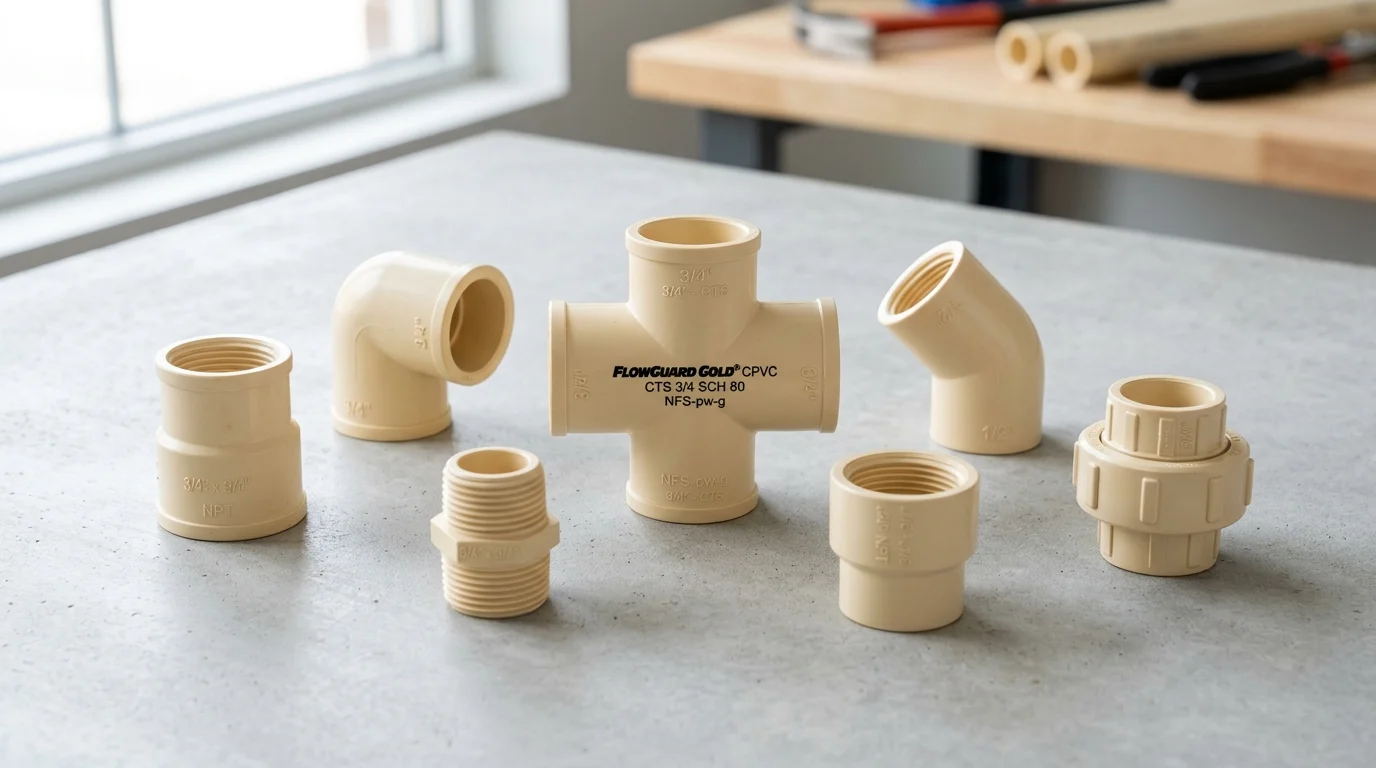
Chlorinated Polyvinyl Chloride (CPVC) fittings have become foundational components in modern commercial plumbing and industrial fluid handling. Engineered by chlorinating standard PVC resin, these fittings withstand significantly higher temperatures and corrosive environments, making them viable alternatives to traditional metallic systems.
With a maximum continuous operating temperature of 200°F (93°C), CPVC bridges the gap between the thermal limitations of standard plastics and the high installation costs of metal alloys. Understanding the material properties and deployment strategies of CPVC is essential for mechanical engineers and procurement specialists aiming to optimize system performance.
Lifecycle cost and installation speed
The primary driver for CPVC adoption in commercial projects is the substantial reduction in lifecycle and installation costs. Unlike copper or steel piping that requires skilled welding, soldering, or heavy threading equipment, CPVC utilizes a two-step solvent cement process. This chemical welding technique reduces installation labor time by 15% to 30% depending on pipe diameter and system complexity.
Furthermore, the lightweight nature of the material—weighing approximately one-sixth that of carbon steel—eliminates the need for heavy lifting machinery on standard commercial sites. Over a 50-year expected lifecycle, the material’s immunity to internal scaling and corrosion eliminates the costly maintenance and total system replacements frequently associated with metallic piping.
Common plumbing applications
Commercial applications for CPVC fittings span potable water distribution, hydronic heating, and specialized fire suppression networks. In commercial fire sprinklers, CPVC fittings approved under NFPA 13, 13R, and 13D standards offer a distinct advantage due to their lower internal friction. The material maintains a Hazen-Williams C-factor of 150 throughout its life, allowing for smaller pipe diameters and lower pump head requirements compared to aging metallic pipes.
Additionally, CPVC’s inert chemical profile makes it highly suitable for industrial processing lines dealing with strong acids, bases, and salts. It is routinely specified in chemical processing facilities, wastewater treatment plants, and institutional laboratories where aggressive fluid transport is a daily operational requirement.
Standards and ratings for compliant CPVC fittings
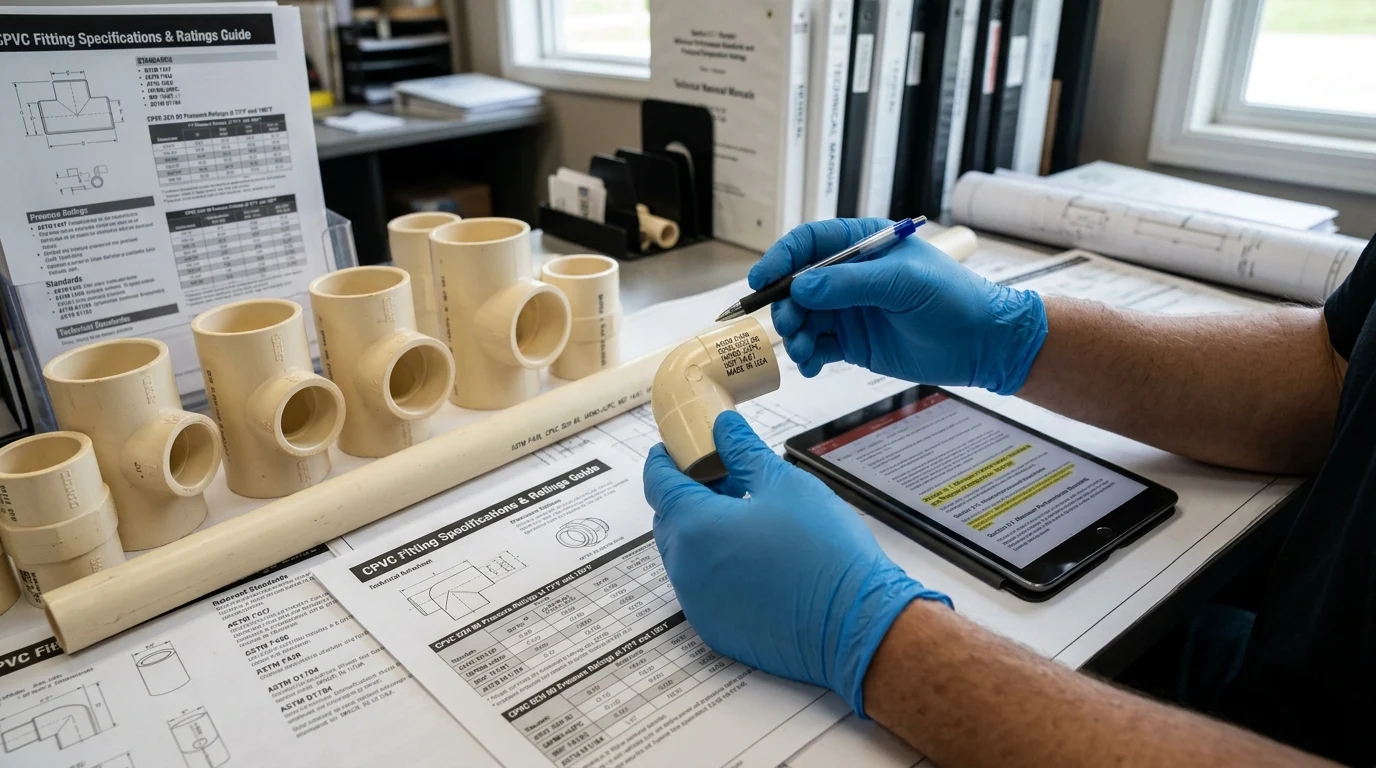
Specifying CPVC fittings for commercial and industrial projects requires strict adherence to established dimensional, material, and safety standards. Regulatory compliance ensures that the fittings will handle designated pressure loads without catastrophic failure over their expected service life.
ASTM, NSF, and listing requirements
Manufacturers must produce CPVC fittings in accordance with rigorous ASTM specifications. For Copper Tube Size (CTS) systems, ASTM D2846 governs the dimensions and performance of pipe and fittings. For industrial Iron Pipe Size (IPS) applications, ASTM F437 covers Schedule 80 threaded fittings, ASTM F438 dictates Schedule 40 socket fittings, and ASTM F439 specifies Schedule 80 socket fittings.
Furthermore, any fitting intended for potable water distribution must carry NSF/ANSI 14 and NSF/ANSI 61 certifications to verify that no harmful compounds leach into the drinking water. Leading manufacturers maintain strict quality control environments, holding dimensional defect rates below 0.1% to maintain these critical third-party listings.
Pressure, temperature, and schedule ratings
Pressure capabilities of CPVC fittings are intrinsically linked to the operating temperature and the specific schedule of the fitting. While a 2-inch Schedule 80 CPVC fitting boasts a pressure rating of 400 PSI at 73°F (23°C), this capacity drops significantly as the fluid temperature rises. Engineers must apply a temperature derating factor to calculate the maximum safe operating pressure.
For instance, at 180°F (82°C), the derating factor is 0.25, reducing the effective pressure rating of that same 2-inch fitting to exactly 100 PSI. Threaded fittings require an additional 50% reduction in pressure capacity compared to socket-welded equivalents.
| Operating Temperature (°F) | Operating Temperature (°C) | CPVC Derating Factor |
|---|---|---|
| 73 | 23 | 1.00 |
| 100 | 38 | 0.82 |
| 140 | 60 | 0.50 |
| 180 | 82 | 0.25 |
| 200 | 93 | 0.20 |
CPVC fittings vs PVC, PPR, and copper
Selecting the optimal piping material involves evaluating CPVC against standard PVC, Polypropylene Random Copolymer (PPR), and traditional copper. Each material presents specific thermal and mechanical thresholds that dictate its suitability for commercial plumbing.
Key performance comparison
The most critical distinction between CPVC and standard PVC is thermal tolerance. While PVC is strictly limited to fluid temperatures of 140°F (60°C), the extra chlorine in the CPVC polymer chain elevates its maximum operating temperature to 200°F (93°C).
When compared to PPR, which typically handles temperatures up to 170°F (76°C) for continuous commercial use, CPVC offers a slightly higher thermal ceiling. Furthermore, CPVC possesses lower thermal conductivity than copper, reducing the mandatory thickness of exterior insulation required to maintain energy code compliance in hot water distribution.
| Material | Max Continuous Temp | Joining Method | Hazen-Williams C-Factor |
|---|---|---|---|
| CPVC | 200°F (93°C) | Solvent Cement | 150 (Constant) |
| PVC | 140°F (60°C) | Solvent Cement | 150 (Constant) |
| PPR | 170°F (76°C) | Heat Fusion | 150 (Constant) |
| Copper | >250°F (121°C) | Soldering/Press | 130 (New) / 100 (Aged) |
Durability, code acceptance, and thermal expansion
Durability and code acceptance heavily favor CPVC in aggressive water conditions. Copper is highly susceptible to pitting and pinhole leaks in environments with low pH water (below 6.5) or high chlorine concentrations, whereas CPVC remains unaffected. Additionally, CPVC exhibits superior resistance to biofilm formation compared to both PPR and copper, making it preferred for healthcare facility water lines.
However, engineers must mathematically account for thermal expansion. CPVC has a thermal expansion coefficient of 3.4 x 10^-5 in/in/°F. A 100-foot straight run of CPVC will expand approximately 4.1 inches given a 100°F temperature increase. This physical property mandates the strategic placement of expansion loops and offsets that might not be necessary for rigid metallic systems.
How to select CPVC fittings
Procurement and specification of CPVC fittings demand a systematic approach to ensure component compatibility, long-term reliability, and supply chain efficiency. Buyers must evaluate both the technical parameters of the fittings and the operational integrity of the manufacturer.
Step-by-step selection process
The selection process begins with identifying the correct sizing standard: CTS (Copper Tube Size) or IPS (Iron Pipe Size). CTS fittings, typically available in 1/2-inch to 2-inch diameters, are standard for residential and light commercial potable water. IPS fittings, manufactured in sizes up to 24 inches, are utilized for heavy industrial processing and large-scale commercial distribution.
Next, specifiers must choose between Schedule 40 (thinner wall, lower pressure) and Schedule 80 (thicker wall, higher pressure) based on the calculated maximum system pressure at the peak operating temperature. Mixing CTS and IPS systems requires specialized transition adapters.
Manufacturer quality and traceability
Sourcing from reputable manufacturers requires verifying ISO 9001 quality management certifications and requesting lot traceability documentation. High-quality CPVC fittings should be injection-molded from virgin resin to guarantee structural uniformity.
Procurement teams should specify that any regrind material used in the manufacturing process must not exceed a 5% threshold. Higher ratios of regrind can compromise the tensile strength and pressure rating of the final fitting. Batch testing reports for burst pressure and dimensional tolerances should be established as standard deliverables prior to shipment.
Logistics, storage, and solvent cement handling
Logistical planning must account for Minimum Order Quantities (MOQs), which typically range from 5,000 to 10,000 pieces for direct factory imports of smaller diameter fittings. Proper inventory storage is also critical; CPVC fittings must be shielded from prolonged ultraviolet (UV) exposure.
Outdoor storage exceeding two years will lead to surface degradation, discoloration, and a measurable reduction in impact strength. Additionally, the procurement of solvent cement must align with ASTM F493 standards, ensuring chemical compatibility with the specific CPVC resin formulation being installed.
When to specify CPVC fittings

Finalizing the specification of CPVC fittings requires matching the material’s empirical strengths against the specific environmental and operational demands of the project. When deployed in the correct context, CPVC delivers unparalleled longevity and performance.
Project conditions that favor CPVC
Project conditions that strongly favor CPVC over metallic alternatives include coastal environments where external saline corrosion degrades copper and steel rapidly. Internally, facilities utilizing highly chlorinated water, such as commercial aquatic centers or advanced water treatment plants, benefit from CPVC’s inherent immunity to chlorine degradation.
Furthermore, retrofitting projects in occupied commercial buildings strongly favor CPVC due to the absence of open flames during installation. The solvent cement process eliminates the need for expensive hot-work permits and dedicated fire watches, significantly streamlining project timelines.
Final specification checklist
Before finalizing procurement documents, engineers should run through a strict specification checklist. First, verify that the derated pressure capacity of the chosen CPVC schedule exceeds the maximum anticipated system pressure by a safety margin of at least 20%.
Second, ensure that the expansion loop calculations are integrated into the spatial layout of the piping chases to prevent mechanical stress on the joints. Finally, confirm that the specified solvent cements and primers comply with local environmental regulations, such as SCAQMD Rule 1168, which mandates Volatile Organic Compound (VOC) limits strictly below 490 g/L for CPVC welding compounds.